

How Have Georgia Venture Capital Trends Changed?

Georgia venture capital trends follow a pattern that has also appeared across the Southeast. Investment reached a high point in 2021, declined as investors became more cautious, and began to stabilize during 2024 and 2025.
Venture capital is equity funding for private companies that investors believe can grow quickly. The investor receives an ownership interest, while the company receives capital that it may use for product development, hiring, sales, or expansion. Venture capital differs from a loan because the company does not repay it through scheduled principal and interest payments.
A venture capital firm manages one or more venture capital funds and uses them to make equity investments in companies with strong growth potential. Each firm sets its own investment criteria, company-stage preferences, and industry priorities.
The Technology Association of Georgia reported that venture capital investment in Georgia exceeded $4 billion in 2021, which set a state record at the time. Low interest rates, high technology valuations, and strong investor demand contributed to a national funding surge during that period.
Conditions changed after 2021. Investors examined valuations more carefully and asked companies for stronger evidence of revenue, customer demand, and efficient spending. The 2025 State of Startups in the Southeast report describes 2023 and 2024 as a correction period and 2025 as a return to greater stability.
What Does the Recent Investment Data Show?
The available reports do not provide one universal total for Georgia startup funding. Research firms and public organizations may cover different companies, locations, transaction types, and reporting periods.
Investment amounts can also vary considerably between seed-stage companies and established businesses completing later funding rounds. A reliable comparison must use the same geographic area, funding stages, and transaction definitions.
The following comparison keeps those differences visible.
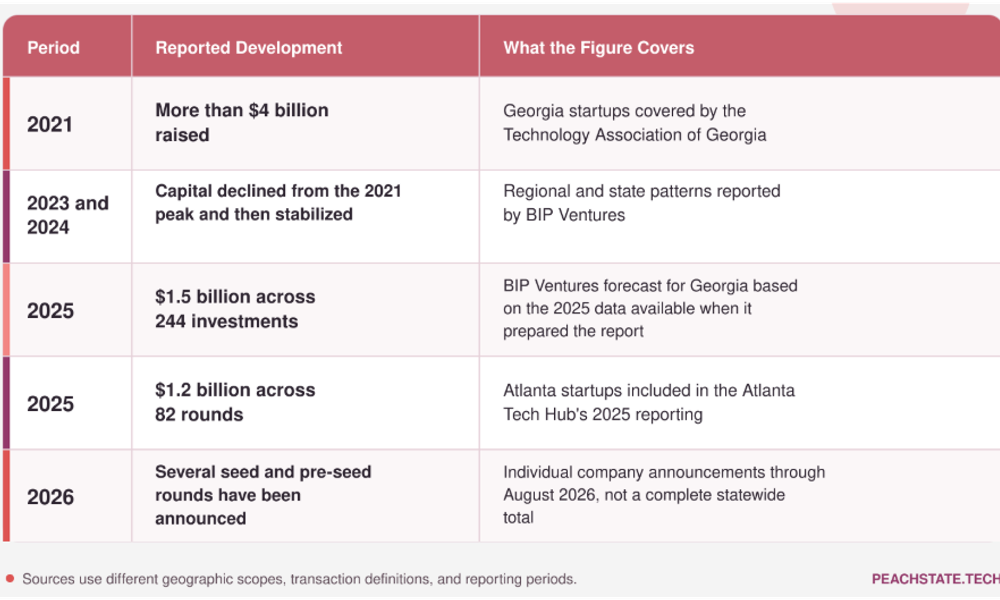
BIP Ventures reports that Georgia companies received about $17.7 billion across 3,236 investments from 2018 through its 2025 forecast. Its report projected $1.5 billion across 244 Georgia investments for 2025. The report also found that capital deployment had remained relatively steady since 2023 even though the number of deals had declined.
BIP Ventures also reports that many VC firms have directed more follow-on capital to existing portfolio companies. These companies have already given investors evidence about their revenue, customers, and operating results.
The Atlanta Tech Hub reported a different but narrower figure. According to its 2025 Tech Impact Report summary, Atlanta startups raised $1.2 billion across 82 funding rounds in 2025. The Atlanta total should not be presented as the amount raised by every startup in Georgia.
These figures indicate continued investment, but they do not show that every funding stage has recovered equally. Fewer deals can make fundraising difficult for young companies even when the total amount invested remains stable.
Why Can Large Funding Rounds Change the Annual Total?
One large transaction can account for a substantial part of the capital reported during a year. A higher funding total does not always mean that more startups received investment.
Atlanta-based Flock Safety provides a clear example. The company raised $275 million in March 2025 in a round led by Andreessen Horowitz. Reuters reported that the financing valued Flock Safety at $7.5 billion and increased its total funding to more than $950 million.
A round of that size can raise the annual total even when seed and early-stage companies face stricter requirements. Deal count, median deal size, funding stage, and total capital provide a more complete view when they are available from the same dataset.
Which Georgia Companies Raised Capital in 2026?
Georgia companies have announced new rounds during 2026, but the current announcements do not form a complete statewide total. They show that investors remain active across artificial intelligence, logistics, enterprise software, and defense technology.
Recent examples include the following.
- Atlanta-based Pull Logic closed a $3.3 million seed round in January. The company develops software that helps manufacturers, distributors, and retailers manage product availability.
- Huper raised $1.5 million in pre-seed funding to develop an AI system that organizes operational information for business leaders.
- Atlanta-based Askari Defense closed a $9 million seed round in June for its autonomous defense technology.
- The Cox Cleantech Accelerator increased its investment to $250,000 for each company in its 2026 cohort. Accelerator investments differ from conventional venture rounds, but they can help early-stage companies test and commercialize products.
These rounds vary in size, company stage, and investment structure. They should be treated as examples of current activity, not proof that total Georgia funding will increase for the full year. Peach State Tech's latest Georgia technology news tracks additional funding, product, hiring, and public-market developments across the state.
Which Industries Attract Georgia Venture Capital?
Information technology receives the largest share of Georgia investment by both deal count and capital, according to BIP Ventures. The category includes software companies that use artificial intelligence in products, business operations, and technical infrastructure.
Healthcare and financial technology also remain important parts of Georgia's funding market. Atlanta already has established companies, trained workers, universities, and potential customers in these industries. Those resources can help a startup test a product and connect with people who understand the market.
Georgia's established financial services sector also creates opportunities for fintech startups that develop payment, compliance, fraud prevention, and banking technologies. Investors can evaluate these products within a state that already supports banks, payment companies, and financial technology workers.
Other funded companies work in logistics, supply-chain software, cybersecurity, clean technology, aerospace, and advanced manufacturing. The 2026 rounds for Pull Logic and Askari Defense show that investors are also supporting companies that apply software or engineering to physical operations.
Artificial intelligence alone does not guarantee investment. BIP Ventures reports that Southeast investors increasingly expect companies to explain how AI improves a product, reduces costs, or creates measurable value. Peach State Tech's guide to AI companies in Atlanta growing in 2026 provides more examples of companies with documented funding, hiring, product launches, or other activity.
Why Does Atlanta Receive Much of Georgia's Startup Funding?
Atlanta venture capital activity benefits from the city's concentration of investors, universities, corporate headquarters, accelerators, and technology companies. This concentration gives founders more opportunities to meet investors, recruit employees, test products, and find business customers.
Georgia investors include venture capital firms, angel investors, corporate investment groups, and family offices. These investors may support different industries, company stages, and investment amounts.
Georgia Tech supports company formation through CREATE-X and the commercialization of university research through VentureLab. The Advanced Technology Development Center also serves technology companies across Georgia. Peach State Tech's guide to Georgia Tech startups and CREATE-X explains how these programs support different stages of company development.
Venture Atlanta connects startups from across the Southeast with investors. The organization reports that its network includes more than 1,000 alumni companies and that participating companies have raised $8.8 billion. These are organization-reported totals, and they cover the Southeast instead of Georgia alone.
Atlanta's concentration of resources does not mean that every Georgia startup operates there. Founders in Augusta, Athens, Columbus, Macon, Savannah, and other communities may work with statewide programs or travel to Atlanta for investor meetings. Geographic concentration can still create an access problem for founders who operate outside the metropolitan area.
How Does Georgia Support Early-Stage Investment?
Georgia uses public programs, university resources, accelerators, and investor events to help companies prepare for funding. These programs serve different founders and do not guarantee that a company will receive venture capital.
Their services help technology startups prepare for seed-stage investment and contribute to Georgia's startup ecosystem. Founders still need to meet each program's eligibility rules and each investor's requirements.
The main forms of support include the following.
- The Georgia Venture Capital Program directs public capital into selected private venture funds that target eligible Georgia businesses.
- Invest Georgia manages the state venture program with the Georgia Department of Community Affairs and evaluates participating funds.
- ATDC provides coaching, education, and business connections to technology companies across the state.
- CREATE-X and VentureLab help Georgia Tech students and researchers test ideas, form companies, and prepare research for commercial use.
- Startup Runway Georgia connects underrepresented founders with investors and provides grants through pitch events.
The Georgia Department of Community Affairs allocated $30 million from the State Small Business Credit Initiative to the Georgia Venture Capital Program. The state program generally invests from $1 million to $3 million in selected private venture funds, with limited authority to invest as much as $5 million in larger funds or special opportunities. Those funds then invest in qualifying businesses under the program rules.
What Do Georgia Venture Capital Trends Mean for Founders?
The current market gives founders access to capital, but investors may require more evidence before they complete a deal. A company may need to prove that customers will pay for its product and that the team can use new funding responsibly.
A clear business model and an accurate pitch deck can help investors evaluate how a company plans to use venture capital funding and measure its progress. The documents must match the company's financial records, customer evidence, and current performance.
If you are preparing to seek investment, you can use the following questions to evaluate your funding plan.
- Does your company solve a specific and documented customer problem?
- Can your team show revenue, customer use, signed contracts, or another form of demand?
- Does the requested amount match your company’s next measurable goals?
- Can your company explain its spending, operating costs, and expected cash runway?
- Does venture capital fit your business model and its need for rapid growth?
- Have you reviewed grants, loans, customer revenue, and other funding options?
Venture capital does not fit every company. A founder who takes equity funding gives investors an ownership interest and may accept expectations for rapid growth, future fundraising, or an eventual sale or public offering. Companies that can grow through customer revenue may choose to retain more ownership.
What Should Georgia Track During the Rest of 2026?
The final 2026 funding total will provide only one measure of the market. Georgia also needs to track how many companies receive funding, which stages receive capital, and whether investors support companies outside Metro Atlanta.
Seed and pre-seed activity will show whether new companies can enter the funding pipeline. Later-stage rounds will show whether established Georgia companies can continue growing without relocating. Acquisitions and public listings will also matter because successful exits can return capital to investors and allow experienced founders or employees to support new companies.
Sector distribution deserves similar attention. A year dominated by one large AI or defense round can produce a high total without broad investment across healthcare, fintech, logistics, clean technology, and other Georgia industries.
Georgia Venture Capital Remains Active but Selective
Georgia venture capital remains available in 2026, although investors have become more selective since the 2021 funding peak. Reports from 2025 and the rounds announced in 2026 show continued activity in information technology, artificial intelligence, logistics, defense technology, healthcare, and financial technology. Complete annual data will determine whether that activity produces more deals or concentrates capital among fewer companies.
Explore Peach State Tech for verified updates about Georgia startup funding, local investors, technology companies, and programs that support founders. Peach State Tech will continue to report the individual developments that shape Georgia venture capital throughout 2026.