

Which Georgia Tech Alumni Have Built the Most Successful Startups?
Georgia Tech alumni startups with clearly documented outcomes include Mailchimp and Internet Security Systems, which reached major acquisitions, as well as Stord and Flock Safety, which reported billion-dollar private valuations. Pindrop turned doctoral research into commercial security products, while OneTrust developed governance software for customers in several countries.
Public sources do not rank all Georgia Tech entrepreneurs under one consistent standard. Acquisition prices, private valuations, funding totals, customer adoption, and research impact measure different results, so we selected the following companies through documented business outcomes rather than reputation alone.
We included Georgia Tech startup founders whose companies met at least two of the following criteria:
- Georgia Tech or an official alumni source confirms the founder's connection to the university.
- The person founded or co-founded the featured company.
- A reliable source documents an acquisition, public listing, major private valuation, or substantial funding.
- The company reached customers beyond Georgia or expanded into a national market.
- The company maintains a meaningful connection to Georgia through its headquarters, workforce, research, or founder activity.
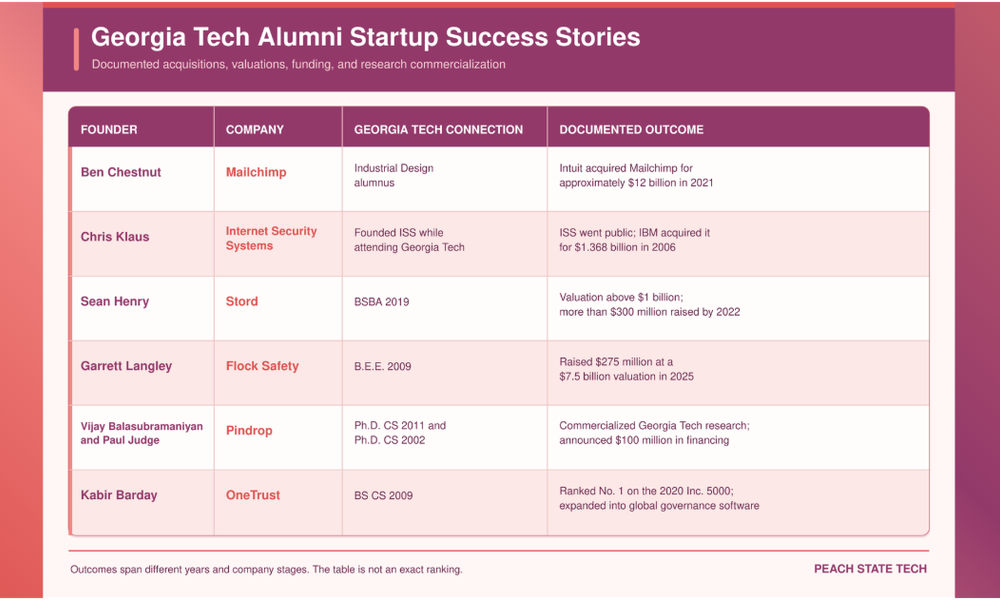
We do not use the table as an exact ranking. Each outcome belongs to a different year and stage of company development, so the profiles below explain what the figures mean.
How Did Ben Chestnut Build Mailchimp?
Georgia Tech's School of Industrial Design identifies Ben Chestnut as an alumnus and the former chief executive officer of Mailchimp, which he co-founded with Dan Kurzius in Atlanta. The company began as an email marketing tool for small businesses and later expanded into marketing automation, customer management, websites, and commerce tools.
Mailchimp remained based in Atlanta as it reached customers around the world. In November 2021, Intuit completed its acquisition of Mailchimp for approximately $12 billion in cash and stock. The transaction created a major documented exit for an Atlanta technology company.
Chestnut's company also expanded Atlanta's position in business software. Mailchimp served small companies that needed accessible marketing tools, so its market extended far beyond Georgia without requiring the company to leave its home city.
How Did Chris Klaus Turn a Student Project Into ISS?
Chris Klaus founded Internet Security Systems while he was a student at Georgia Tech and developed products that helped organizations find network weaknesses and respond to internet threats. ISS later completed an initial public offering before IBM acquired it.
IBM reported that it paid $1.368 billion for ISS in October 2006. The company's 2006 annual report explains that ISS served companies and governments through security software, appliances, and services.
Klaus continued to support founders after the acquisition by helping establish CREATE-X and funding programs connected with entrepreneurship at Georgia Tech. In 2025, he also offered to cover incorporation costs for graduating students who wanted to start companies, according to Georgia Tech.
His experience links an early Atlanta cybersecurity company with the university's newer founder programs. ISS began before CREATE-X existed, so the program did not help launch the company.
How Did Sean Henry Build Stord While Attending Georgia Tech?
Sean Henry co-founded Stord in 2015 while attending Georgia Tech and later earned a business degree from the Scheller College of Business in 2019. Stord combines logistics operations with software that helps brands manage inventory, warehousing, transportation, and order fulfillment.
Henry used Georgia Tech's CREATE-X program during the company's early development before Stord attracted national customers and substantial venture funding. A Georgia Tech commencement profile reported that the company had raised more than $300 million and employed more than 500 people by December 2022.
Georgia Tech described Stord as a billion-dollar company in a 2025 founder profile, although private valuations can change after later funding or business developments. Henry reached customers across the country while using local support during the company's early development.
Founders who want to understand the university's current programs can read Georgia Tech Startups and How CREATE-X Helps Founders Launch. The guide separates CREATE-X from VentureLab and the Advanced Technology Development Center.
How Did Garrett Langley Expand Flock Safety?
Garrett Langley earned a bachelor's degree in electrical engineering from Georgia Tech in 2009 before he founded Flock Safety, an Atlanta company that develops cameras, license plate readers, video systems, and software for public safety work. Georgia Tech's College of Engineering identifies Langley as the company's founder and chief executive officer.
Flock Safety announced a major funding round in March 2025 and raised $275 million at a $7.5 billion valuation. The company also reported more than $300 million in annual recurring revenue and said its products served over 5,000 communities across the United States at the time of the announcement.
Flock Safety's March 2025 funding announcement documented a $7.5 billion private valuation, more than $300 million in annual recurring revenue, and service across more than 5,000 communities. The company reported each figure at the time of the announcement, and later business developments may change them.
Flock remains part of Atlanta's public safety technology market.Our guide to AI companies in Atlanta explains how the company uses machine learning within its products and compares its recent growth with other local businesses.
How Did Georgia Tech Research Lead to Pindrop?
Vijay Balasubramaniyan developed research at Georgia Tech that examined how audio signals could help identify the source of a telephone call. He earned a doctorate in computer science in 2011 and co-founded Pindrop with Georgia Tech alumnus Paul Judge and professor Mustaque Ahamad.
Pindrop turned the research into products for voice authentication and fraud detection before expanding into deepfake detection for calls, online meetings, and other digital communications. Balasubramaniyan and his co-founders converted graduate research into commercial products by addressing problems that customers needed to solve.
Pindrop secured $100 million in debt financing from Hercules Capital in July 2024. The company said it planned to use the financing to develop its audio, voice, fraud-detection, and deepfake-detection technologies. A May 2026 Georgia Tech College of Computing profile also noted that TIME named Pindrop Pulse one of the Best Inventions of 2025.
Pindrop's official company history identifies Balasubramaniyan as chief executive officer, Judge as executive chairman, and Ahamad as chief scientist. The three founders brought research, technical leadership, and company-building experience to the same business.
How Did Kabir Barday Grow OneTrust?
Kabir Barday earned a bachelor's degree in computer science from Georgia Tech in 2009 and founded OneTrust in 2016 after working at AirWatch, another Atlanta enterprise software company. OneTrust develops software for privacy, data governance, consent, risk management, and AI governance.
Georgia Tech inducted Barday into the College of Computing Hall of Fame in 2021 and reported that OneTrust had ranked first on the 2020 Inc. 5000 list of the fastest-growing private companies in the United States. The university also credited the company with securing patents and completing several acquisitions during its first five years.
OneTrust appointed John Heyman as chief executive officer in February 2026, while Barday moved to an advisory role on its board. Barday remains the company's founder, but current coverage should identify Heyman as CEO.
OneTrust identifies Atlanta as its headquarters and lists offices in several countries. The company now emphasizes privacy, consent, data use, technology risk, and AI governance. Barday's work provides another documented example of a Georgia Tech graduate building enterprise software for an international market.
What Do These Georgia Tech Founder Stories Have in Common?
The founders entered different industries, and their companies did not follow one path. Several practical patterns still connect their work:
- Each founder addressed a defined problem involving marketing, cybersecurity, logistics, public safety, communications, or data governance.
- The companies served customers beyond Georgia while maintaining an educational, operational, or leadership connection to the state.
- Technical knowledge supported product development, while customer demand and capital helped the companies expand.
- University programs supported some founders, but other companies began through research or independent work before those programs existed.
- Major outcomes took different forms, including acquisitions, funding, private valuations, national adoption, and research commercialization.
The founders built companies for established industries instead of depending on a general claim about innovation. Each business offered a product that customers could purchase, test, and use in regular operations.
How Does Georgia Tech Support Startup Founders?
Georgia Tech now supports company development through several programs, including CREATE-X, which helps students test ideas, build prototypes, and launch businesses. VentureLab works with faculty members and researchers who want to commercialize technology, while ATDC supports Georgia technology companies at later stages.
The CREATE-X Startup Launch program gives Georgia Tech students $5,000 in seed funding and more than $30,000 in in-kind services. Participants can also receive coaching, legal and accounting services, workspace, mentorship, and intellectual property support.
CREATE-X reports that more than 34,000 students have participated across 38 majors and that more than 770 student startups have reached a combined valuation above $4.5 billion. The totals can change as new teams enter the program and existing companies raise funding.
Each form of startup support serves a different stage, and program participation does not explain every founder's success. Mailchimp and ISS began outside CREATE-X, Pindrop grew from doctoral research, and Stord used CREATE-X during its early development.
Georgia Tech's location in Midtown Atlanta also puts founders near university programs, corporate offices, investors, and startup resources within Tech Square. Our guide to Atlanta tech districts explains how Midtown connects Georgia Tech with other parts of the regional technology market.
What Can Georgia Founders Learn From These Alumni?
You can use the founder profiles as evidence rather than as a formula. A university connection can provide technical knowledge, professional relationships, or access to a program, but your company still needs a product that solves a customer problem.
Your funding plan should also match the company's stage. Mailchimp reached a major acquisition without following the same venture path as Stord or Flock Safety. Georgia's funding market has changed since the investment surge of 2021, so current founders need stronger evidence of customer demand and responsible spending. Our review of Georgia venture capital trends explains the recent shift.
A founder can maintain local operations while building relationships with customers and investors in larger markets. The featured companies reached national customers because their products addressed needs that also existed beyond Atlanta.
What Do Georgia Tech Alumni Startups Show About Georgia?
We measured founder success through several documented outcomes. Mailchimp and ISS completed large acquisitions, Stord and Flock Safety reached billion-dollar private valuations, Pindrop commercialized university research, and OneTrust expanded into international enterprise software.
Georgia Tech alumni startups reached markets beyond the state with support from technical education, research, university programs, or Atlanta business connections. Each founder still had to identify a customer problem, build a usable product, and guide the company through a distinct path to growth.
Follow Peach State Tech for verified coverage of Georgia founders, startup funding, technology companies, and the people shaping the state's business community.