

What Changed for Delivery Robots in Georgia?
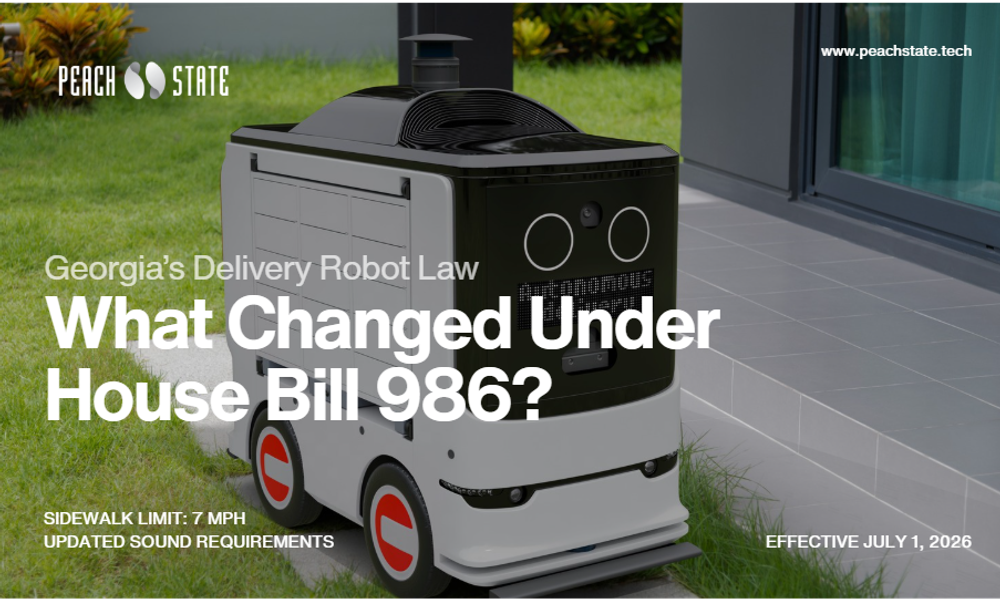
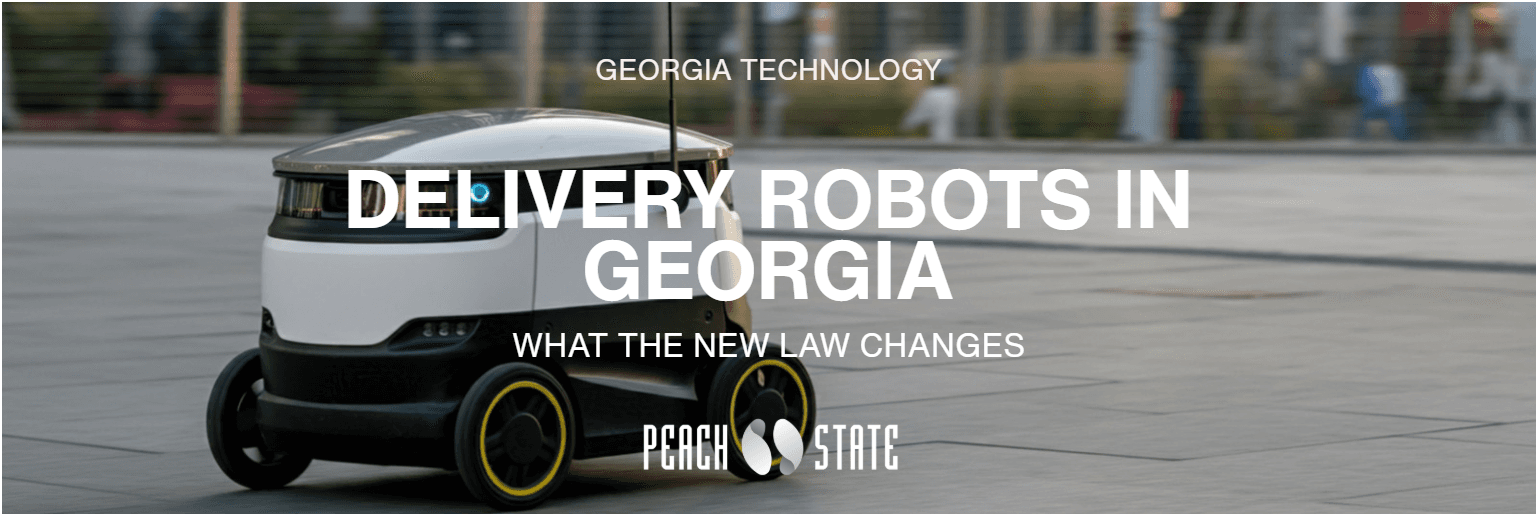
House Bill 986 raised the maximum speed for personal delivery devices on sidewalks, shared-use paths, and safety zones to seven miles per hour. It also raised the maximum speed in crosswalks to seven miles per hour while retaining the existing minimum of 3.5 feet per second.
The law changed the sound requirement, too. A device must emit a sound while moving within six feet of a vehicle, a person on foot, or a wheelchair user. The previous wording referred to a device approaching them. Operators must still exercise care to avoid collisions and yield to pedestrians. You can check these changes in the signed text of HB 986.
The Georgia General Assembly’s 2026 summary of enacted legislation confirms the July 1 effective date. State Rep. Todd Jones was the bill’s lead House sponsor.
Georgia had already established a framework for these devices through HB 1009 in 2022. The newer law adjusts two parts of that framework. Restaurants and delivery companies still have to work within the other operating requirements.
How Much Faster Could Your Lunch Arrive?
A robot traveling one mile at a steady four miles per hour would need 15 minutes. At seven miles per hour, it would need about eight minutes and 34 seconds. That is a theoretical saving of roughly six and a half minutes of travel time.
Your order will also spend time in the kitchen, at crossings, and at the pickup point. A robot may need to slow down around people or wait for assistance. Its own speed limit may also fall below the legal maximum: Avride’s published robot specifications, for example, list a maximum speed of about five miles per hour.
The higher legal limit gives operators more room to work with capable equipment. It does not establish a new arrival time for every order.
How Do Autonomous Delivery Robots Work?
These ground-based robots carry food or other goods in a cargo compartment. Their navigation systems use sensors and software to identify obstacles and guide them along a route. Avride says its robots use cameras, lidar, and ultrasonic sensors, with a remote team available to assist when a robot encounters a problem.
The customer usually handles the order through a participating app. At Georgia Tech, Tech Dining describes a Grubhub and Avride service in which you choose a participating restaurant, select an available campus location, track the delivery, and follow the app’s instructions to collect your food.
You should check the actual drop-off point before ordering. A campus pickup location and your apartment door can be very different destinations. If you need a particular form of access, confirm that the service can accommodate you.
Why Would a Restaurant Use a Robot to Deliver Food?
Consider a hypothetical hamburger order headed to an apartment building half a mile from a restaurant. A driver using a car may need to navigate traffic, find parking, and carry the meal to the handoff point. A small electric robot could complete a suitable trip without using a full-size vehicle.
That is a lot of car to move a sandwich.
The possible saving comes from matching the delivery method to the job. If your customers live close together and your restaurant receives enough eligible orders, a robot service could handle some short trips efficiently. You would still need to compare the provider’s full charges with your current delivery costs.
Someone also has to keep the robots working. Depending on the contract, your restaurant or the provider may pay for:
- Equipment purchases, leases, or delivery-service fees
- Charging, storage, maintenance, and repairs
- Remote assistance and on-site recovery when a robot cannot continue
- Staff time to load orders and resolve customer problems
- Insurance, software, and other operating expenses
The useful figure is the total cost per completed delivery. A low advertised trip price may leave out expenses that your team will still carry. Ask how the provider handles failed deliveries and whether customer fees change during a trial.
Why Do Sidewalks Matter So Much?
For a sidewalk delivery service, a restaurant and a customer can look close on a map while remaining difficult to connect on the ground. Imagine a subdivision half a mile from a restaurant across a busy road. If the path ends halfway there, the operator needs to determine whether another lawful, workable route exists.
A sidewalk gap can add a detour, require a different delivery method, or put the address outside the service area. You need to inspect the full trip, including crossings and the final handoff.
Georgia’s existing framework requires operators to maintain a 48-inch clear path for access by people with disabilities on sidewalks. It also requires them to yield to pedestrians and wheelchair users. Those provisions appear in the 2022 legislation, and HB 986 leaves them in place.
Uneven pavement, steep slopes, construction, blocked curb ramps, and bad weather can create additional challenges. Different robots have different capabilities, so an operator should test the equipment on the proposed route under realistic conditions.
If you use a wheelchair, push a stroller, or walk along a narrow path, you should be able to continue your trip safely. The delivery team needs to plan how its equipment will share that space.
Where Could Robot Delivery Make Sense?
The following examples describe conditions to assess. They do not identify confirmed service areas.
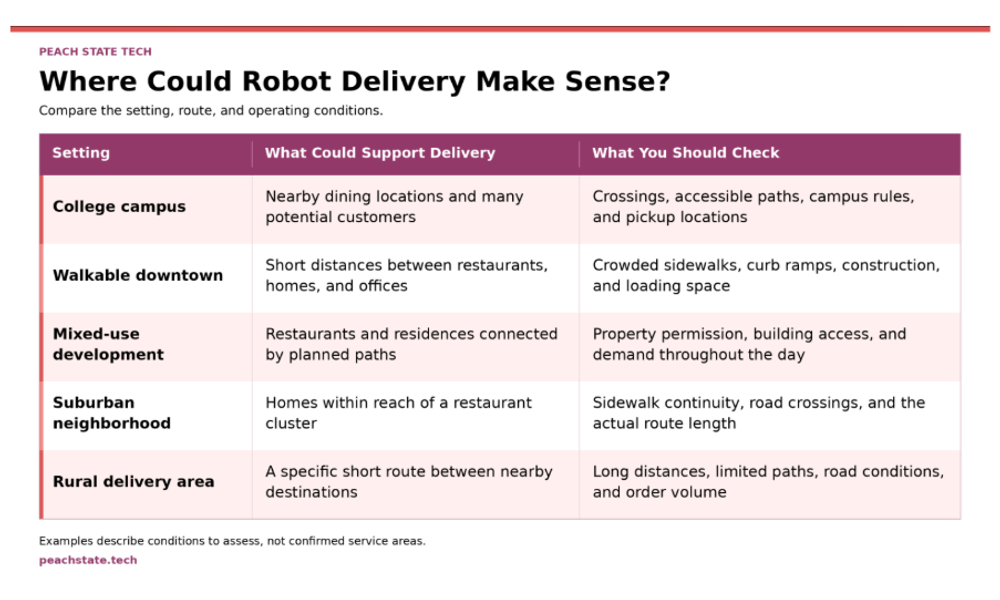
A campus may offer several useful conditions in one place, but the operator still needs permission, suitable routes, and enough customers. A suburban or rural location requires the same review. You still need route tests and delivery data before you can judge whether the service will work.
Where Has Georgia Used Campus Delivery Robots?
Georgia’s experience predates the 2026 speed change. In August 2020, Georgia Southern University announced a 20-robot Starship program for its Statesboro campus. The university described deliveries from campus dining locations to designated outdoor pickup points.
That announcement documents an earlier deployment. You would need current dining information to establish what service is available there today.
Georgia Tech provides a more recent example of how providers can change. In an August 21, 2026, dining update, the institute said Avride would become its new autonomous delivery provider following Starship’s departure. Its mobile-ordering page describes the Grubhub integration and customer instructions.
These examples show why you should check both the announcement date and the current ordering options. A campus’s earlier partnership does not guarantee that the same provider still serves it, and a campus program does not establish availability across the surrounding city.
Could Delivery Robots Replace Human Drivers?
A restaurant could shift some suitable trips from drivers to robots if the service meets its needs at a lower total cost. That possibility matters to anyone who earns money from local delivery.
HB 986 contains no employment forecast. Businesses decide how to staff their services based on their orders, routes, contracts, and operating results. A three-block food delivery and a large grocery order headed ten miles away may require very different equipment and support.
People also remain involved in robot delivery. Employees prepare and load orders, technicians maintain equipment, and support teams respond to problems. Avride’s description of remote assistance offers one example of that continuing human role.
Those tasks do not establish that new positions will replace lost driving income. Any claim about Georgia’s employment effects would need evidence from actual deployments over time.
What Should You Ask Before Trying Robot Delivery?
If you manage a restaurant or property, start with a small service area that your team can evaluate. Ask the provider to demonstrate the complete trip, including the busiest crossing and the customer handoff.
Before you agree to a trial, establish:
- Which routes and addresses the provider can serve under applicable rules
- How the team will protect pedestrian access and handle obstructions
- Who will respond to breakdowns, incidents, and customer complaints
- What you will pay for completed, canceled, and failed deliveries
- Which results you will measure, including delivery time, refunds, and cost per order
You can use those results to decide whether to continue, change the route, or stop the trial. Peach State Tech’s guide to digital transformation across Georgia industries explains how to assess technology projects through their actual stage and measurable results.
Georgia businesses also test automation beyond delivery. Our coverage of Georgia Tech Manufacturing 4.0 offers a separate example of how organizations evaluate robotics and other tools before wider use.
What Does the New Law Mean for Your Next Order?
Georgia has given delivery operators more flexibility on certain routes. Your local service will still depend on the equipment, accessible paths, customer demand, and the people responsible when something goes wrong.
For a restaurant with nearby customers, those details could support a useful delivery option. For a neighborhood without a workable route, the higher limit may change very little. A provider has to demonstrate that it can complete the whole trip safely and reliably.
A robot does not need to transform transportation across Georgia to earn its place. Sometimes a restaurant simply needs a dependable way to get your sandwich down the street.
Follow Georgia’s Technology Developments
Peach State Tech follows delivery robots in Georgia and other technologies that affect your work, business, and daily life. Explore more coverage to see where organizations are testing new tools and what their results show.