

What Digital Transformation Trends Are Shaping Georgia?
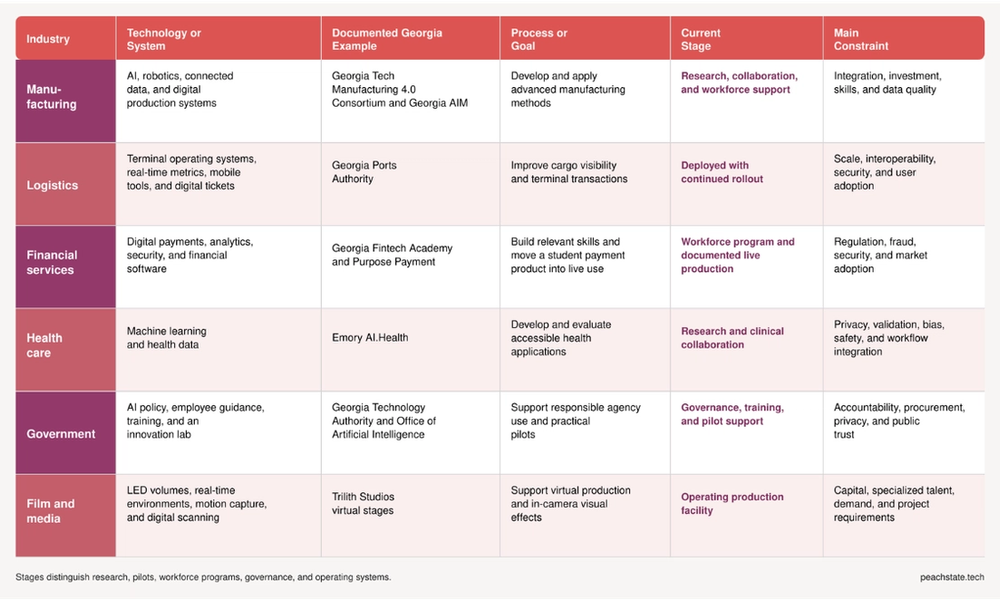
Digital transformation trends in Georgia center on connected manufacturing, real-time logistics data, digital payments, clinical AI, public-sector governance, and virtual production. These projects change how people complete work or receive a service. The clearest examples name the organization, explain the system, show its current stage, and identify a result that employees or customers can evaluate.
Digital transformation goes beyond buying new software. A useful project changes a process, improves the flow of information, supports a decision, or makes a service easier to use. This distinction matters because a research program, a pilot, and a fully operating system do not provide the same proof.
Georgia Digital Transformation Evidence Map
How Is Manufacturing Becoming More Connected?
Smart manufacturing connects production equipment with data, automation, and decision tools. Georgia Tech's Manufacturing 4.0 Consortium gives companies access to research, facilities, training, and collaboration with academic and government partners.
Georgia Tech also studies the Internet of Things, artificial intelligence, robotics, secure data integration, and real-time decisions. Georgia AIM supports AI in manufacturing and works to expand workforce access across the state.
These programs can help a manufacturer explore new methods, but each company still has to make the technology work on its own floor. If you manage a plant, you need to connect the new system with your equipment, data, employees, and quality controls. A narrow production problem gives you a practical place to start.
Our report on Georgia Tech Manufacturing 4.0 offers more background on this work. You can use that context to compare the research with the needs of your own operation.
How Are Georgia Logistics Organizations Using Digital Systems?
The Georgia Ports Authority offers a clear example of digital technology in daily operations. In April 2025, the authority said its terminal operating system provided immediate container updates and tracked vessel productivity, truck turn times, dual truck moves, and rail-container dwell time.
GPA has also introduced mobile tools for truck drivers. The GPA Trucker app provides terminal information and digital transaction tickets. In 2026, the authority said Ocean Terminal used digital tickets and Garden City Terminal had begun a gradual rollout of facial recognition at its gates. These details show an active rollout at specific terminals. They do not describe a statewide standard for every logistics provider.
This example also shows why logistics technology can be difficult to scale. A port connects shipping lines, rail systems, trucking companies, government requirements, and customer platforms. If your organization works in that chain, you need to examine data access, cybersecurity, downtime procedures, and driver adoption along with speed and capacity.
How Is Technology Changing Georgia Financial Services?
Georgia's fintech sector works with digital payments, lending software, fraud controls, financial data, cybersecurity, and regulatory technology. The Georgia Department of Economic Development identifies fintech as an important part of the state's technology economy and links the sector with Georgia's digital infrastructure and workforce programs.
The Georgia Fintech Academy shows how workforce development can support that sector. The academy connects the University System of Georgia with fintech employers. It offers courses, projects, events, and career programs that cover subjects such as payment processing, financial analytics, information security, and digital-payment security.
The academy's 2025 impact report says Purpose Payment, a student-led payment solution, moved from an idea into live production during 2025. That milestone shows progress for one product. The report does not establish broad commercial adoption or a financial return.
If you work in financial services, speed is only part of the customer experience. Your organization must also protect information, prevent fraud, keep services available, document controls, and follow the rules that apply to the product. Weak identity checks or unreliable records can erase the benefit of a faster transaction.
How Is Health Care Digital Transformation Developing in Georgia?
Health care organizations use digital systems for medical records, remote services, predictive models, clinical decision support, and administration. Each use requires evidence that matches the risk. A research model does not need the same review as a tool that affects patient care.
The Emory Empathetic AI for Health Institute provides a current Georgia example. Emory says the institute uses machine learning and large health datasets to study prevention, diagnosis, treatment, and health outcomes. The institute aims to develop, deploy, and scale accessible AI tools, although individual projects may sit at different stages of research or implementation.
Emory researchers have also discussed possible uses of AI in rural health, including population-health analysis and triage support. Trained professionals remain responsible for clinical decisions. Before a health system uses a tool in routine care, its team must protect patient information, test performance across relevant groups, monitor errors, and fit the tool into established clinical work.
If you see a promising result from a study, check what happened next. The model may still need more testing, technical integration, regulatory review, and staff training before clinicians can rely on it.
How Is Georgia State Government Managing Digital Change?
Public agencies have to improve services while protecting transparency, privacy, accessibility, security, and accountability. Georgia created an Office of Artificial Intelligence within the Georgia Technology Authority to guide responsible AI use in state government. GTA publishes principles, policies, standards, and employee guidance that cover data quality, fairness, human oversight, and approved uses.
Those rules affect everyday choices. An employee needs to know whether a system may receive public information, confidential records, or personal data. Georgia directs agencies to review the relevant policies before they buy, develop, or regularly use AI. State guidance also tells employees to protect confidential material and verify generated content.
GTA's 2025 IT success stories describe an innovation lab where agencies can explore and implement AI through practical projects. The lab supports pilots and implementation. Its work does not show that every agency uses the same tools. Our article about Georgia's approach to AI governance explains the state's approach in more detail.
If your team provides a public service, define the problem and the people affected before you expand an automated system. You should also name the reviewer, the appeal route, and the procedure that staff will follow when the system fails.
How Is Production Technology Affecting Georgia Film and Media?
Virtual production combines physical sets with digital environments that a production team can see while filming. The process may use LED walls, real-time rendering, motion capture, digital scanning, and previsualization. It can help a team plan environments earlier and capture some visual effects during production. Skilled creative and technical workers still guide the process.
Trilith Studios in Fayetteville provides a current operating example. Its virtual stages include a fully enclosed LED volume. Trilith also lists planning, visualization, LED content creation, and post-production visual effects among its services. The facility gives productions access to these tools, but each project decides whether the method fits its story, schedule, and budget.
If you plan a virtual production, you still need to coordinate camera work, lighting, digital assets, technical crews, and schedules. An LED volume may reduce some location or post-production work, while the project may require more preparation and specialized labor.
Georgia Film Academy programs train students in production, post-production, live broadcasting, streaming, and esports. Facilities can provide advanced tools, but trained people turn those tools into a finished production.
What Shows That Digital Transformation Is Producing Value?
A new system can produce an output faster while leaving the full process unchanged. Your organization needs measures that connect the technology to the problem you set out to solve. Look for this evidence:
- A defined process or customer problem that the project addresses
- A documented baseline from the previous method
- An employee or team responsible for implementation, review, and final decisions
- A measurable result tied to the complete workflow rather than one isolated task
- Controls for data, security, quality, compliance, downtime, and failure
Suppose a tool creates a draft, prediction, or transaction in seconds. Your team may lose that saved time if employees must correct the output or move it between systems by hand. Your cost calculation should include integration, training, subscriptions, security, maintenance, and the effect of errors. The best measurement follows the work from its first input to a verified result.
What Should Georgia Organizations Check Before Expanding a System?
A limited project can help your organization learn before it makes a larger investment. Your test needs a clear owner, an approved data boundary, and a fair comparison with the current process. Ask these questions before you expand it:
- Which process will change, and which user will experience the change?
- Who owns the result and reviews the system's output?
- Which data enters the system, and who may access or retain it?
- How will the team compare quality, time, cost, and risk with the previous method?
- What will employees do when the system fails or produces an incorrect result?
- Which workforce, legal, security, integration, and ongoing cost requirements affect expansion?
Your own workflow provides the most useful evidence. Another company's result may depend on different data, employees, customers, infrastructure, or regulations. A pilot supports a larger decision only when the test reflects the conditions that the expanded system will face.
What Comes Next for Digital Transformation in Georgia?
Georgia gives organizations access to research institutions, industry programs, digital infrastructure, and working examples. You still need reliable data, skilled employees, secure systems, and a measurable goal before those resources can produce value for your organization.
Health care, financial services, and government often require extensive validation and documentation because an error can affect a person's safety, money, rights, or access to services. Manufacturing, logistics, and media projects face serious limits too, including integration work, capital costs, and shortages of specialized skills.
Some infrastructure projects can support several sectors at once. Research on digital twin technology in Atlanta shows how data models may help teams plan transportation and public spaces. Each use still needs its own evidence, owners, and safeguards.
Where Can Readers Follow Georgia Digital Transformation News?
Start with the organization that operates the program or system. Agency, university, port, health-system, and company sources can help you verify the details. Check the publication date and determine whether the source describes research, a pilot, a planned investment, or an active deployment. Peach State Tech also follows Georgia companies, research programs, workforce developments, and technology initiatives as they change.
Digital transformation trends will continue to develop at different speeds across Georgia's industries. Peach State Tech helps you follow the companies, institutions, technologies, and workforce changes that shape the state's economy. As you review each new claim, check its source, current stage, and measurable effect before you treat it as proof of wider change.