

How Digital Twin Technology Supports Event Planning
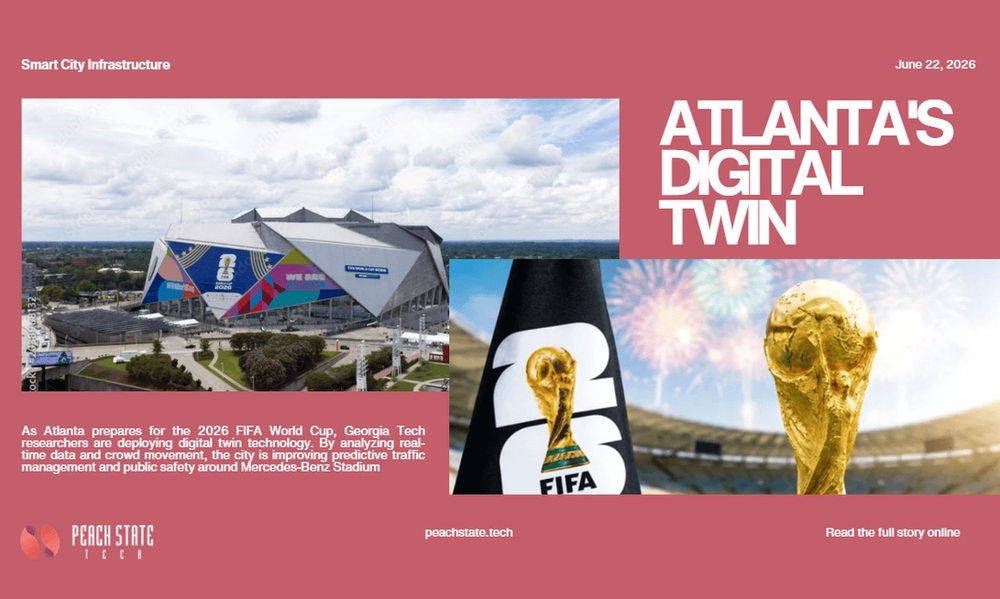
Atlanta faces a significant operational challenge as the 2026 FIFA World Cup brings large crowds into the city. Digital twin technology is helping Georgia Tech researchers prepare for increased pressure on transportation networks, public safety operations, and pedestrian movement around Mercedes-Benz Stadium. The initiative demonstrates how Georgia research institutions are applying advanced technology to real-world infrastructure challenges.
The project brings together researchers from Georgia Tech's Aerospace Systems Design Laboratory, the Georgia Tech Police Department, and the Georgia World Congress Center Authority. Their goal is to create a virtual environment that mirrors conditions around the stadium and nearby transportation corridors. By combining operational data, machine learning, artificial intelligence, and data analytics, the team can study how people and vehicles move through the city before major disruptions occur.
The concept of digital twins involves creating a digital model that continuously updates using information from the physical world. This approach allows organizations to evaluate operational decisions before implementing them in physical systems. Public safety officials and urban planners can use these insights to identify potential problems and improve coordination during high-traffic events.
Improving Predictive Traffic Management with Real-Time Data
A major objective of the initiative is improving predictive traffic management around key World Cup venues. The platform uses real-time operational data to monitor changing conditions and forecast traffic patterns throughout the day.
Several capabilities support this effort.
- Real-time monitoring of vehicle and pedestrian movement
- Predictive analysis of traffic congestion risks
- Evaluation of road closures and traffic diversion plans
- Decision support for public safety and transportation teams
These tools help officials respond more quickly and make informed decisions during periods of heavy activity. Predictive traffic management reduces uncertainty and helps maintain mobility throughout the event area. The project also provides valuable information that city leaders can use when planning future transportation improvements.
Building Smart City Infrastructure Beyond the Tournament
Although the World Cup is the immediate focus, the long-term value of the initiative extends beyond the tournament. The project represents an important investment in smart city infrastructure and supports broader infrastructure development efforts across Atlanta.
Digital twin technology can help cities evaluate transportation systems, public safety programs, and future development projects. The same framework used during the World Cup can support campus planning, transit expansion, and municipal operations long after the final match concludes.
Many local organizations are pursuing digital transformation strategies that connect technology with daily operations. Digital twins provide a practical way to understand how physical systems perform under different conditions. Better visibility into system performance supports stronger planning, resource allocation, and operational efficiency.
Population growth continues to increase demands on transportation networks and public services throughout major urban areas. Smart infrastructure solutions help communities adapt to these pressures while maintaining reliability and supporting economic growth.
Using Crowd Management Analytics to Improve Public Safety
Managing large crowds is one of the most important responsibilities during any global sporting event. Crowd management analytics provides public safety teams with better visibility into pedestrian movement and changing conditions throughout the event area.
The digital twin platform combines machine learning and data analytics to identify movement patterns and forecast congestion risks. Public safety officials can use these insights to improve planning and reduce operational challenges before they escalate.
Several benefits support event operations.
- Improved pedestrian flow around high-traffic areas
- Faster identification of congestion hotspots
- Better emergency response planning
- Greater awareness of changing crowd conditions
These capabilities help create safer experiences for visitors while reducing operational strain on local agencies. The project also gives city leaders valuable information that can be applied to future public events across Georgia.
Artificial Intelligence and the Future of Urban Operations
The initiative reflects broader advances in artificial intelligence and automated decision-support systems. Organizations increasingly rely on intelligent technologies to analyze large amounts of information and support operational planning.
Digital twin technology connects data from the physical world to a virtual environment where different scenarios can be evaluated safely. Artificial intelligence helps process large datasets and identify patterns that may not be visible through manual analysis alone.
Many organizations already use similar approaches for predictive maintenance, resource planning, and operational optimization. As these technologies mature, digital twins will support a wider range of applications across transportation, public safety, energy efficiency, and infrastructure management.
Data quality remains a critical requirement for success. Accurate operational data ensures that digital models reflect real conditions and provide reliable recommendations. Strong data management practices allow organizations to gain meaningful value from their digital transformation initiatives.
Why Digital Twin Technology Matters for Georgia
The work taking place at Georgia Tech demonstrates how digital twin technology can support smart city infrastructure, predictive traffic management, and crowd management analytics within a single operational framework. By combining machine learning, artificial intelligence, and data analytics, cities can better understand how complex systems behave under changing conditions.
The insights gained during the 2026 FIFA World Cup will provide valuable guidance for future infrastructure development projects across Atlanta and the broader region. Digital twin technology gives urban planners and public safety leaders a practical way to improve efficiency, address potential problems, strengthen smart infrastructure, and build more resilient cities that can adapt to future demands.
The project highlights how Georgia research institutions continue to apply advanced technologies to real-world challenges. As Atlanta prepares for the 2026 FIFA World Cup, the initiative offers a strong example of how innovation can support transportation, public safety, and long-term urban development across the state.
Breakthroughs in areas such as digital twin technology, artificial intelligence, and smart infrastructure are transforming how communities solve complex challenges. Peach State Tech provides ongoing coverage of the research, companies, and industry leaders advancing innovation across Georgia.