

What Does Georgia Tech VentureLab Do?
Georgia Tech VentureLab works with researchers who want to explore commercial uses for technology developed at the university. Engineers and entrepreneurs on its staff help each team study the market, reduce early technical and commercial risks, and decide whether the invention could support a company.
A research team may have promising test results without knowing which customers need the technology or whether the invention can become a practical product. VentureLab helps answer those questions before the founders commit substantial resources to a launch.
According to its current website, VentureLab does not charge participating teams or take equity in their companies. Its main forms of startup support include:
- Evaluating possible commercial uses for Georgia Tech research
- Helping researchers follow the university's invention disclosure process
- Organizing customer discovery and business model testing
- Connecting teams with students, mentors, and industry advisers
- Guiding eligible teams toward grants, loans, investors, and other programs
- Preparing research-based startups for company formation and growth
The program reports that it has supported hundreds of startups that have collectively raised more than $1.5 billion in investments. VentureLab publishes a combined result rather than an amount for each company or a count of companies that remain active.
Who Can Work With VentureLab?
VentureLab primarily works with Georgia Tech faculty members, researchers, and graduate students who are developing university-owned inventions. A team may also include a VentureLab principal and advisers with relevant business experience.
Undergraduate students with independent startup ideas will usually find a closer match in CREATE-X. VentureLab may still advise some CREATE-X teams after they finish that program, but its central role involves the commercialization of Georgia Tech research.
Students can gain direct experience through VentureLab's Entrepreneurship Assistant Program. The paid position places students with research teams to explore applications, interview potential customers, and study markets. VentureLab currently describes a commitment of 10 to 15 hours per week and says applications open during the fall semester.
How Does VentureLab Turn Research Into a Startup?
VentureLab begins when its staff learns about Georgia Tech research with possible commercial value. Staff members examine the invention, possible applications, and work that could reduce market or technical risk. The team does not need to incorporate a company at the start because the researchers must first identify a customer problem and test a business model.
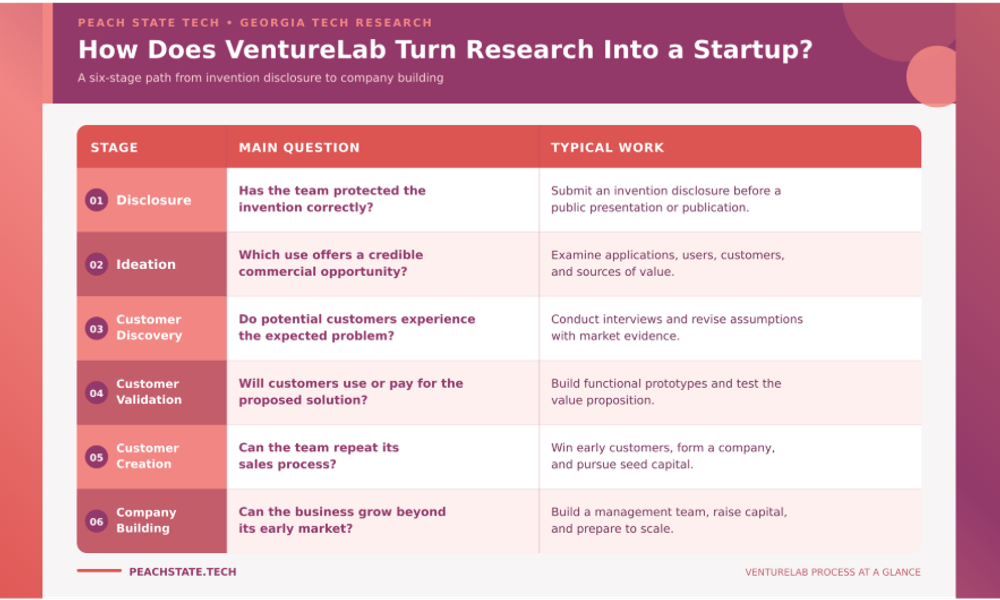
VentureLab adapted the four-stage customer development model associated with entrepreneur Steve Blank by adding ideation at the beginning. The extra stage gives researchers time to compare possible uses before they focus on one market.
Why Must Researchers Disclose an Invention First?
Georgia Tech asks researchers to follow its invention disclosure process before they reveal an innovation through a paper, poster, presentation, or other public communication. The disclosure gives the Georgia Tech Research Corporation, which owns university-developed intellectual property, an opportunity to evaluate the invention and consider appropriate patent filings.
Public disclosure can affect the ability to obtain patent protection in some countries. Researchers therefore need to contact Georgia Tech's intellectual property staff early instead of waiting until a conference presentation or journal publication approaches. An invention disclosure does not guarantee a patent or require the researchers to form a company. It gives the university the information needed to assess available protection and commercialization paths.
VentureLab also helps researchers consider whether a startup provides a suitable route to market. Some inventions may fit an established company's product line and reach users through a licensing agreement instead.
How Does Customer Discovery Test a Research Idea?
Customer discovery helps a research team compare its assumptions with the experiences of potential users, buyers, and other stakeholders. VentureLab expects teams to leave the laboratory and conduct interviews before they commit to a product design or sales plan.
Researchers begin with a business thesis that describes the proposed product, its customer, and the reason that customer may buy it. VentureLab advises teams to learn about the interviewee's problems before presenting the invention because an early sales pitch can influence the answers.
Customer interviews help the team determine:
- Whether the proposed user experiences the problem often enough to seek a solution
- How the organization handles the problem now
- Which person uses the product and which person approves the purchase
- What technical, financial, or regulatory barriers could delay adoption
- Whether another application offers a stronger commercial opportunity
VentureLab's published process uses 100 interviews as a major customer discovery benchmark. The number alone does not prove that a market exists, so teams must interpret the evidence and return to ideation when interviews do not support their assumptions.
Customer validation adds practical tests. Researchers build an initial functional prototype and determine whether customers will commit time, data, money, or another meaningful resource. VentureLab describes three to five early customers as evidence that a sales process may be repeatable, although a company must still prove that the model can scale.
What Funding Can VentureLab Teams Pursue?
VentureLab helps eligible research teams identify funding that matches their stage. Outside agencies, nonprofit organizations, lenders, and private investors make separate award decisions under their own requirements.
The Georgia Research Alliance offers commercialization funding for spinouts based on research from Georgia universities. VentureLab's current program page lists a $50,000 Phase 1 grant and a $100,000 Phase 2 grant, both awarded to the university. A launched spinout may qualify for a Phase 3 loan of up to $250,000, while eligible GRA-funded companies may seek equity investment from the GRA Venture Fund.
The National Science Foundation's I-Corps Teams program combines customer discovery training with funding for eligible research teams. VentureLab currently describes seven weeks of training and an award of up to $50,000, from which a $10,000 participation fee is deducted. Applicants usually need a technical lead, an entrepreneurial lead, and an industry mentor, but they should check the current NSF solicitation for complete rules.
Federal SBIR and STTR programs can support research and product development when a company meets agency requirements. VentureLab also works with angel investors and venture capital firms after a team gathers enough evidence to justify outside investment. Our review of Georgia venture capital trends explains the wider funding environment.
Which Startups Has VentureLab Helped?
Georgia Tech identified Suniva, CardioMEMS, Innovolt, and Pindrop Security as notable VentureLab graduates in a 2013 report. Their work covered solar energy, medical devices, power protection, and cybersecurity.
The report provides historical evidence rather than a current company ranking. Georgia Tech stated that VentureLab had launched more than 150 companies that had attracted over $700 million in outside funding by 2013.
Pindrop offers one example of research commercialization. Vijay Balasubramaniyan developed telephone security research during his doctoral work at Georgia Tech and co-founded the company with professor Mustaque Ahamad and alumnus Paul Judge. Our guide to Georgia Tech alumni startups examines Pindrop and other founder outcomes in greater detail.
How Is VentureLab Different From CREATE-X?
CREATE-X primarily helps undergraduate students test ideas, build prototypes, and launch companies. Its programs cover problem and market analysis, prototype work, and company launch.
VentureLab mainly supports graduate students and faculty teams that want to commercialize Georgia Tech-owned research. Both programs use evidence-based entrepreneurship, and VentureLab may continue advising a suitable team after CREATE-X ends.
How Is VentureLab Different From ATDC?
VentureLab helps a research team investigate possible markets and determine whether an invention could support a startup. The Advanced Technology Development Center, or ATDC, works with technology companies that need help developing operations, raising capital, and scaling.
Some companies move from VentureLab into ATDC after they form and validate an early business model. Admission remains a separate process, and a research team does not enter ATDC automatically.
Each program occupies a different point in Georgia Tech's entrepreneurship system. VentureLab connects research with early commercial evidence, while ATDC concentrates on company development.
What Results Has VentureLab Reported?
VentureLab's current website reports hundreds of supported startups and more than $1.5 billion in combined investments. Georgia Tech also cites a second-place worldwide ranking that the program received in 2013.
Georgia Tech formed VentureLab in 2001. In its 2013 study of 150 university-based business incubators across 22 countries, UBI Index ranked VentureLab second overall and first in two narrower categories covering early-stage programs and support for a broad range of technologies.
The ranking remains useful historical recognition, but it does not establish VentureLab's current position against programs worldwide. A responsible 2026 account should name the study year and avoid presenting the result as a new award.
What Should Researchers Know Before Contacting VentureLab?
You should be ready to explain the research, the problem it may solve, and the invention's current stage. VentureLab staff will also need to know about planned publications or presentations that could affect intellectual property decisions.
Prepare to identify possible users, buyers, and industry stakeholders even when you have not selected one market. VentureLab will require you to test those ideas through interviews rather than treat initial assumptions as facts.
Commercialization also requires people with enough time to support customer discovery, prototype development, and company formation. VentureLab can help build a team, but faculty members and students must decide how much responsibility they can accept.
What Role Does VentureLab Play in Georgia's Startup Economy?
VentureLab links Georgia Tech research with funding programs, industry advisers, and potential customers. Its partnerships connect qualified teams with resources at different stages of development.
Atlanta gives research founders proximity to employers in logistics, finance, healthcare, manufacturing, and cybersecurity. Relevant organizations can provide market knowledge or become partners and customers. VentureLab also operates within the wider Midtown and Tech Square Atlanta technology district and startup ecosystem.
VentureLab cannot take sole credit for every company or investment associated with its portfolio. Its defined role involves helping a research team move from a technical result toward evidence of a commercial opportunity.
How Can Researchers Get Started With VentureLab?
Researchers can begin by reviewing VentureLab's process and contacting a staff member. The team should address Georgia Tech's invention disclosure requirements early, especially when an upcoming publication could reveal the technology.
VentureLab staff can help researchers compare applications, form a commercialization team, and prepare for customer discovery. Applicants should confirm current requirements before they plan around any grant, loan, or training award.
What Does VentureLab Add to Georgia Tech's Innovation System?
Georgia Tech VentureLab gives university research startups a structured way to protect an invention, investigate customer needs, test a business model, and pursue suitable funding. Its work strengthens Georgia Tech research commercialization by helping researchers make decisions with market evidence.
Peach State Tech covers the researchers, founders, companies, and programs shaping Georgia's technology economy. Discover Peach State Tech for more reporting on university innovation, startup funding, and commercial technology.