


Where to Find Tech Networking and Mentorship in Georgia
You can find tech networking in Georgia through professional associations, startup programs, career communities, university initiatives, and statewide business advisers. The right resource depends on whether you want to meet industry peers, develop a company, receive career guidance, or join a structured mentorship program.
Each organization provides a different kind of access. Some programs connect participants with mentors, while others offer coaching, events, office hours, or a place to meet people with similar goals. You should confirm the audience, eligibility rules, cost, and current schedule before you register or apply.
Where Can You Find Tech Networking in Georgia?
Your goal should guide where you begin. A technology professional may use the Technology Association of Georgia to meet people in a specific field. A startup founder may need ATDC coaching or UGA Small Business Development Center consulting. A student may gain more from a program designed for a particular school or career stage.
You may also need more than one resource. A founder can learn through a startup program, meet peers at a community event, and build industry relationships through a professional association. The source map below shows what each organization provides and where its limits begin.
Georgia Technology Networking and Mentorship Source Map
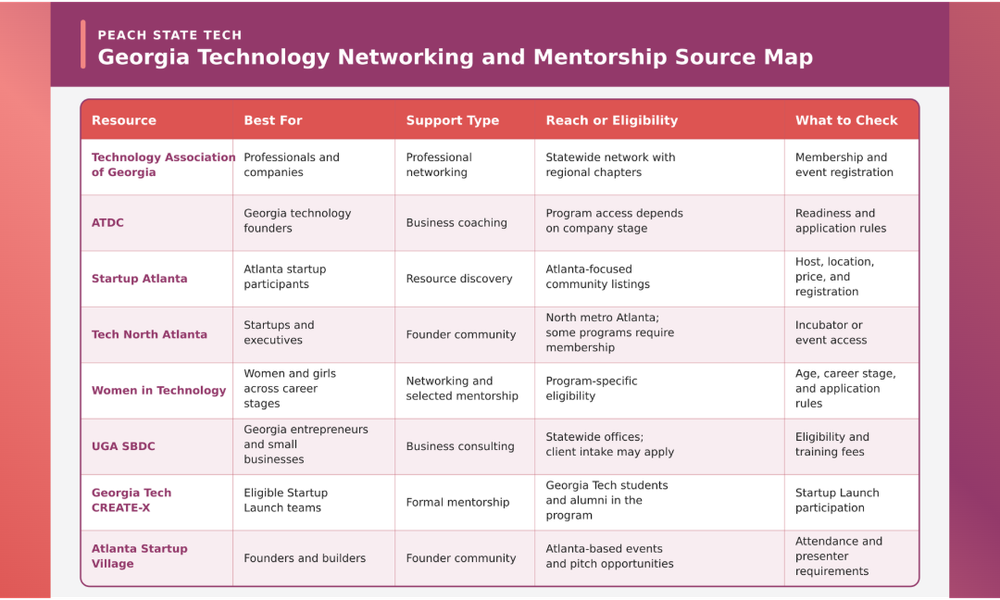
The table separates mentor matching from general access to a community. An event can introduce you to helpful people, while a coaching program may provide focused business advice without creating a long-term mentoring relationship.
How Do Networking and Mentorship Differ?
Networking helps you build relationships with people who share an industry, role, location, or business interest. You may meet someone at a panel, workshop, professional society, or founder event. The first conversation often gives you information, a useful contact, or a reason to continue the relationship.
Formal mentorship creates a defined relationship. A program may pair you with an experienced professional and set expectations for future conversations. Eligibility rules often control who can participate.
Business coaching and consulting serve another purpose. An adviser helps you examine a specific challenge, such as customer discovery, financial planning, commercialization, or company growth. The adviser may support your decisions without serving as a personal mentor.
Clear expectations protect everyone’s time. A focused question and evidence of your effort can help a useful relationship develop through repeated contact.
Which Georgia Organizations Help Technology Professionals Build Connections?
TAG offers one of the broadest entry points into Georgia’s technology community. The association runs professional societies in areas such as data science, artificial intelligence, cybersecurity, fintech, digital health, and supply chain technology. It also operates regional chapters and a statewide event calendar. TAG’s official membership page refers to events, societies, and mentorship programs, but membership alone does not promise that the organization will assign you a mentor.
Startup Atlanta serves a different purpose. Its calendar helps founders, investors, builders, and community members find events from different hosts. The calendar works well when you want to see what is happening across Atlanta without visiting every organization’s website. Each host controls its own audience, price, format, and registration process, so you should open the original event page before making plans.
Tech Alpharetta now operates as Tech North Atlanta. The organization focuses on the north metro Atlanta technology community. Its work includes executive events and a startup incubator that provides community, education, mentoring, and connections. Incubator access differs from ordinary event attendance, and the organization may apply separate membership or participation rules.
Atlanta Startup Village gives founders another community setting. Founders can present companies, answer questions, receive live feedback, and meet people in the startup ecosystem. Attendance does not guarantee individual mentorship.
Job seekers can combine these communities with the sources in our guide to technology jobs and career fairs across Georgia. A community event can help you understand an employer or field, while the official employer page should guide any application.
Where Can Georgia Startup Founders Find Guidance?
The Advanced Technology Development Center supports Georgia technology companies through programs for different stages. ATDC Educate helps entrepreneurs develop knowledge and connections. ATDC Accelerate serves founders working toward product-market fit, while ATDC Signature supports companies at a later growth stage. Coaching and selection requirements change across those programs.
ATDC can fit a founder who needs technology-startup guidance and a community that understands scalable companies. A founder should review the current program descriptions before assuming that an idea, product, or company qualifies for a particular path.
The UGA Small Business Development Center offers confidential, no-cost, one-on-one consulting for eligible Georgia small-business owners. Its consultants help clients examine business plans, capital needs, finances, marketing, and management. UGA SBDC also provides statewide commercialization services for entrepreneurs evaluating technology, markets, milestones, intellectual property basics, or funding strategies.
UGA SBDC provides business consulting. Clients should not expect automatic mentor matching. A consultant may help you solve a defined problem without entering an open-ended advisory relationship. New and established businesses may also follow different intake steps.
Tech North Atlanta can suit a founder who wants an incubator community in the north metro area. Atlanta Startup Village can suit someone who wants pitch practice, direct questions, and feedback in a public founder setting. Your location, company stage, and desired level of support should decide which route deserves your time.
Relationships can help a founder understand investors, but no networking program can guarantee funding. Our review of Georgia venture-capital trends in 2026 explains why investors still examine customer demand and business fundamentals.
Which Mentorship Programs Serve Students and Early-Career Professionals?
Women in Technology provides programs for women and girls at several education and career stages. Its pre-career work includes experiences and mentorship for students, while its Careers in Action programs provide professional development and networking for women who want to launch, change, or advance a technology career. WIT also identifies an Early Career Mentorship Program within its program structure.
Choose the WIT program that matches your stage because student, early-career, and professional programs have different audiences. WIT states that its community has no membership fee, but individual programs and events may still have registration rules.
The Georgia Tech CREATE-X Mentorship Program connects experienced entrepreneurs, industry veterans, and alumni with Georgia Tech students who participate in Startup Launch. Georgia Tech describes Startup Launch as a summer program for eligible students and alumni who want to turn projects into operating startups.
CREATE-X does not operate as a general mentorship directory for every student or Georgia resident. Its mentorship program supports Startup Launch participants. Georgia Tech founders who are commercializing university research may also need the intellectual property and customer-discovery support described in our guide to Georgia Tech VentureLab.
How Should You Choose a Georgia Technology Community?
A polished event page can look promising, but the format may not match what you need. Use five checks before you spend time on an application, membership, or event ticket:
- Your goal: Decide whether you want a career connection, founder advice, peer community, investor exposure, or formal mentorship.
- Your eligibility: Check public access, membership rules, company stage, university affiliation, career stage, and application requirements.
- Your geography: Confirm whether the program serves the whole state, Atlanta, north metro Atlanta, a regional chapter, or a specific campus.
- Your commitment: Compare a single event with recurring meetings, office hours, incubator participation, or a structured cohort.
- Your cost and timing: Review current dues, ticket prices, application windows, attendance rules, and program availability.
Read the official page after you narrow your options. An organization may change its schedule, delivery format, capacity, or program name. A direct check also helps you avoid relying on an old event listing or a copied description.
How Can You Prepare for a First Networking or Mentor Conversation?
You do not need an elaborate pitch. You need enough clarity to help the other person understand who you are and what kind of conversation would be useful.
- Introduce yourself clearly: Use one sentence to explain your work, career goal, or company.
- Ask a focused question: Choose a question that fits the person’s experience and gives them enough context to respond.
- Show your effort: Explain what you have researched, tested, or attempted before asking for advice.
- Respect the time: Stay within the agreed conversation and avoid requesting an open-ended commitment during the first meeting.
- Follow up thoughtfully: Send a short message that mentions the useful point you discussed and any action you plan to take.
A productive conversation may end with one practical suggestion. The person does not need to offer you a job, investment, introduction, or long-term mentorship for the meeting to have value. Apply the advice when it fits, then share a concise update if the relationship continues.
What Should You Verify Before You Join?
Check the current program page for its intended audience, location, schedule, cost, application status, and delivery format. Look for a named organizer or contact if the page leaves an important requirement unclear.
You should also confirm what the program means by support. Mentor matching creates a different experience from group coaching, founder office hours, peer discussion, a conference, or a public event calendar. Specific language helps you set a realistic expectation before you participate.
Geography deserves the same care. An organization may describe a statewide mission while holding many activities in metro Atlanta. Regional chapters, online sessions, or local offices can expand access, but they may not provide the same program in every Georgia community. Check the location and format for the exact opportunity you plan to use.
Build Your Place in Georgia’s Technology Community
Choose one resource that matches your current goal, confirm its requirements, and attend or apply with a specific question in mind. Explore Peach State Tech’s latest coverage as you build your knowledge and use tech networking in Georgia to form relationships that support your next step.