



Where Can You Track Georgia Job Growth?

You can track Georgia job growth through the Georgia Department of Labor and the U.S. Bureau of Labor Statistics. Georgia’s economic development department and local authorities publish expansion announcements. The Bureau of Economic Analysis provides economic-output data, while the Technology Association of Georgia publishes reports that add context about technology sectors.
Each resource helps you answer a different question about Georgia, the U.S. state. You might need to know whether employment increased across an industry, whether a company opened a facility, or how a county’s economy changed. Start with that question so you can choose information that supports your decision.
A statewide employment figure gives you broad context. A local project update can explain what a particular employer plans to do. You will often need both before you can judge an announcement’s significance.
Which Sources Help You Track Jobs and Tech Expansion?
The sources below cover employment, economic output, project announcements, and technology-sector activity. Use their geographic coverage and limitations to decide where to begin.
Georgia Job Growth and Tech Expansion Source Map
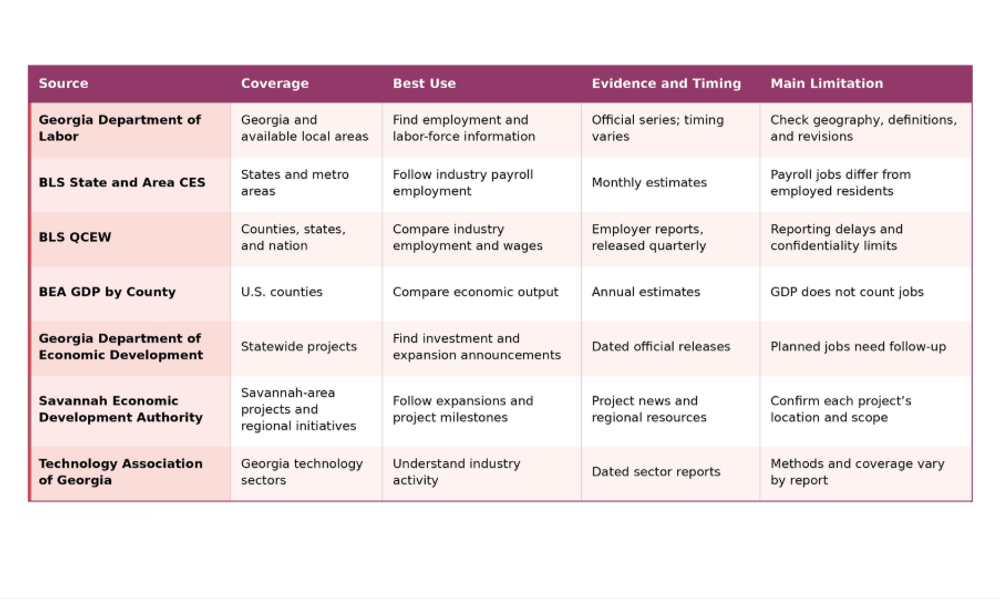
The table follows different research needs rather than ranking organizations. Several sources cover all industries, so you will need to select the categories relevant to your work. GDOL and BLS also publish related federal-state information; identical figures on their websites may come from the same underlying program.
How Can You Use Each Source?
What Can You Find Through Georgia’s Department of Labor?
The Georgia Department of Labor’s current-data page links to unemployment, labor-force, and industry employment information. You can use it to locate statewide figures and available local comparisons without starting with a company announcement.
Check the period shown inside the release. A page you open today may describe an earlier month, and preliminary figures may later change. Save the publication date alongside the measurement period so you can explain exactly what you reviewed. You should also confirm whether the table covers a county, city, or metropolitan area before comparing it with another source.
How Does BLS Track Monthly Payroll Employment?
The Bureau of Labor Statistics runs the Current Employment Statistics program, known as CES, with state partners. It produces monthly estimates of employment, hours, and earnings for states and metropolitan areas using establishment payroll information.
CES counts jobs at workplaces. Someone who appears on two employers’ payrolls can be counted twice. You should therefore use these figures to examine payroll employment and use resident-based labor-force statistics when your question concerns employed people living in an area.
Keep comparisons consistent. If one figure is seasonally adjusted to account for recurring seasonal patterns, compare it with another figure on the same basis. BLS can revise estimates as additional information becomes available.
What Does QCEW Add to a County Comparison?
The Quarterly Census of Employment and Wages, or QCEW, provides detailed information about employment, establishments, and wages by industry. BLS publishes county and state data from employer reports, subject to disclosure restrictions.
You can use QCEW to investigate a particular industry within a Georgia county. Choose the same industry category and period for each area you compare. The data arrive after the period they describe, so they will not immediately confirm a recent hiring announcement. Some detailed local figures may also be withheld to protect confidential information. A missing figure should not be interpreted as zero employment.
How Can BEA Help You Understand Economic Growth?
The Bureau of Economic Analysis publishes county gross domestic product, or GDP, estimates. GDP measures economic output and helps you examine the size and growth of a county’s economy. You still need employment information to understand changes in jobs.
The data year matters here. BEA’s county page displayed its release covering 2024 when checked on September 26, 2026. Those figures describe the earlier year even though BEA published them in 2026.
BEA has also discontinued publishing certain aggregated geographic statistics, including metropolitan-area GDP. Use its current county resources and read the methodology before attempting your own regional comparison.
Where Does Georgia Announce Business Expansions?
The Georgia Department of Economic Development publishes official releases about business investment, new locations, and expansions. Its news page gives you a starting point for identifying projects and the organizations involved.
Read the full announcement before recording a job figure. Look for the project’s county, expected hiring period, investment description, and any conditions mentioned. Preserve the distinction between what the company plans and what it reports completing. A release that says an employer expects to create positions over several years does not confirm that the employer has filled them today.
How Can You Follow Projects Around Savannah?
The Savannah Economic Development Authority, or SEDA, publishes project news and provides regional business resources. Its news center includes announcements and operating milestones that can help you follow a project beyond its initial release.
Use SEDA as a regional starting point, then check the location named in each story. Savannah, Chatham County, and the wider area refer to different geographies. A nearby project may fall outside the county you are studying. If you are comparing local employment, match the project’s actual location to your dataset before drawing a conclusion.
What Can TAG Add to Your Technology Research?
The Technology Association of Georgia, or TAG, publishes reports on technology sectors and related business activity. These resources can help you understand the organizations, services, and industry relationships behind broader employment figures.
Choose a report that matches your question and check its publication date. Review the underlying sources before quoting a workforce or economic figure. A sector overview, an association impact report, and an employment study have different purposes. Pay particular attention to how the report defines technology, since that definition determines which companies or workers appear in its totals.
How Can You Tell Planned Jobs From Employment Growth?
An employer may announce a hiring target years before it reaches that workforce size. You can record the target as a plan and look for later evidence of progress, such as a dated staffing update. A facility opening establishes another milestone, but you still need evidence about its workforce.
Consider a hypothetical manufacturer that announces a new plant and expects to hire over three years. The company later opens the building and begins recruiting. You can describe the opening and active recruitment accurately, while the final hiring target remains a future goal until the employer provides supporting information.
Use four checks when you review an announcement:
- Identify whether the figure describes planned positions, filled roles, or an employment estimate.
- Record the location and the period the figure covers.
- Check whether the source separates temporary construction work from permanent operating roles.
- Find later company or authority updates and note what remains unconfirmed.
Net employment growth also accounts for changes elsewhere in the measured area and industry. One employer may hire while another reduces its workforce. You cannot add selected hiring announcements together and treat the result as total net growth across Georgia. A regional total also cannot tell you how many people a specific company hired.
Keep investment figures separate as well. A company may allocate money to buildings, equipment, or other expenses, and the investment amount alone cannot establish its permanent staffing level. Our coverage of Georgia venture capital trends offers related context for interpreting funding activity.
What Counts as Technology Employment?
Your definition of technology employment affects which data you need. An industry describes an establishment’s main business activity. An occupation describes the work a person does.
A software developer can work for a manufacturer, while a software company can employ salespeople, accountants, and administrative staff. Industry employment and occupational employment therefore answer different questions. BLS’s Occupational Employment and Wage Statistics program provides occupation-based information that can help you investigate particular types of work.
The distinction matters when you assess Georgia tech industry growth. A new automated warehouse or advanced factory may employ technicians and engineers alongside workers in other roles. Describe the available role information before calling every position a technology job.
Our guide to digital transformation across Georgia industries explains how organizations apply technology in different settings. You can use that context to understand a project’s operations, then check workforce evidence separately. A business can adopt new systems without its announcement explaining how employment will change.
How Can You Build a Useful Monitoring Routine?
You can keep a manageable record by choosing a clear question first. A founder studying potential customers may follow industry expansions, while a professional considering a career move may concentrate on relevant occupations and employers.
- Choose your region and the industries or occupations you want to follow.
- Save the relevant employment data and its comparison period.
- Record project announcements separately from employment totals.
- Revisit releases and project updates, noting revisions and changes in status.
A simple spreadsheet can hold the source link, location, measure, period, project status, and date you last checked. Keep the original announcement so you can compare it with later updates without losing the earlier wording.
You might review announcements weekly and return to statistical releases when their publishers issue updates. Adjust that routine to your needs because monthly, quarterly, and annual resources follow different schedules.
If your goal is employment, use the research to guide your next search. The guide to Atlanta technology employers can help you identify companies to investigate. Confirm individual openings through each employer’s current career page.
Follow Georgia’s Technology Economy With Better Evidence
Follow Peach State Tech for reporting on the companies, technologies, and workforce developments affecting your community. Use these sources to assess Georgia job growth, check expansion claims, and decide which developments deserve a closer look.