



How Do You Move a Company to Another State?

You move a company to another state by deciding where its legal entity will remain, registering in the new state when required, and updating its operating records. An existing company may keep its original state of formation and register as a foreign entity in Georgia. An owner may instead form a new Georgia entity and transfer appropriate operations or assets to it.
A physical move does not automatically change the state that created an LLC or corporation. The legal structure needs separate attention because the decision can affect taxes, contracts, licenses, ownership records, and reporting duties.
Several terms help explain the available paths:
- Domestic entity: Georgia law governs an entity created in Georgia.
- Foreign entity: Another state or country created the entity, which now seeks authority to conduct business in Georgia.
- Foreign qualification: An out-of-state company registers for authority to conduct business in Georgia.
- Registered agent: An eligible person or organization receives legal and official documents for the business at a Georgia registered office.
In state business law, “foreign” can refer to a company from another U.S. state. The word does not apply only to international companies.
Your business type and business structure affect the relocation process. A sole proprietor, LLC, corporation, and partnership may follow different registration and tax procedures. Confirm how Georgia classifies your business entity before you select a filing.
Should You Keep the Existing Entity or Form a Georgia Business?
Choose your legal path before you file forms or close accounts. Each option creates different responsibilities.
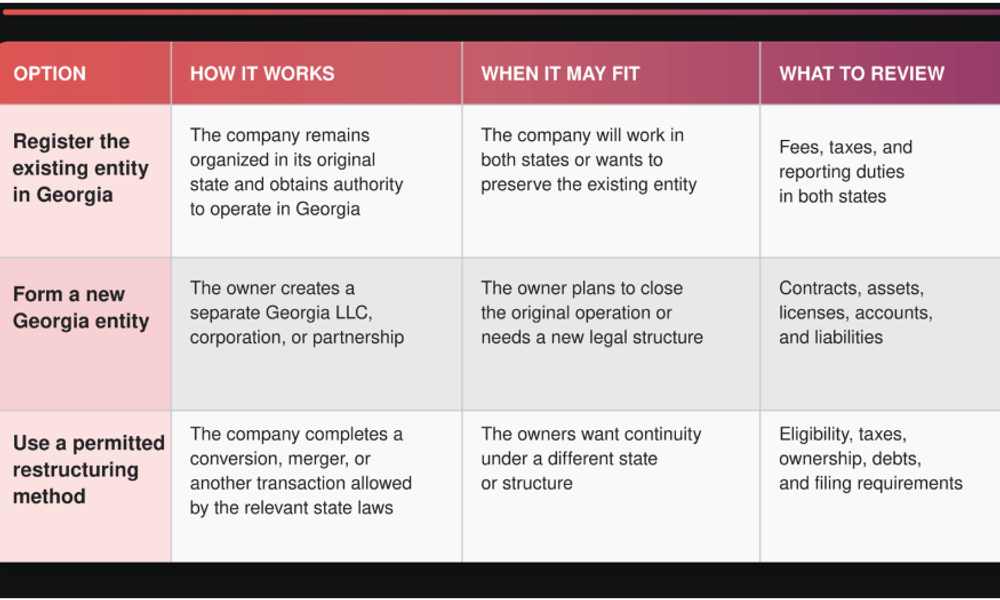
The Georgia Secretary of State’s online system separates new domestic businesses from existing non-Georgia businesses. A domestic entity begins its legal existence in Georgia. A foreign entity keeps its original formation and applies for authority to conduct business in Georgia.
If you create a new Georgia entity, you will need the correct formation documents for your chosen structure. Georgia LLCs generally file articles of organization, while corporations file articles of incorporation.
No single option fits every relocation. Ask a business attorney and tax professional to assess your original state, entity type, contracts, assets, debts, and future activities before you make the change.
What Should You Check Before Relocating a Business to Georgia?
A relocation plan should begin with the obligations that the move may affect. Review these items before signing a lease or filing an application:
- Decide whether the company will continue operating in its original state.
- Review contracts for notice, consent, assignment, or address requirements.
- Identify tax accounts in the original state and Georgia.
- List all federal, state, local, and professional licenses.
- Confirm where employees will work and which payroll rules apply.
- Check zoning, occupancy, signage, and property requirements for the new location.
- Ask insurers whether the move changes coverage or premiums.
You should also list every record that contains your current address, including bank accounts, payroll systems, shipping accounts, insurance policies, government filings, and online profiles.
How Do You Register an Out-of-State Business in Georgia?
An LLC, corporation, limited partnership, or other eligible entity formed outside Georgia may need a certificate of authority before it conducts business in the state. The U.S. Small Business Administration explains that companies active in more than one state may need foreign qualification in each state where they operate.
The activities that trigger registration depend on your entity and its operations. Ask an attorney whether your Georgia activities meet the legal standard for conducting business.
Confirm the Business Name
Conduct a name search through Georgia’s business records and review the state’s naming standards. The results can show entities with similar names, but the search does not provide a final name availability decision.
Georgia may require you to use an alternate name if your legal business name conflicts with an existing name or fails to meet state requirements. If you operate under another name, you may also need to register a trade name, commonly called a DBA, with the Clerk of the Superior Court in the county where your business is located. Georgia provides a separate trade-name filing guide for this county-level process.
Appoint a Georgia Registered Agent
An entity registered in Georgia must continuously maintain an eligible registered agent and registered office in the state. The registered agent receives service of process and official communications for your company. The agent must use a physical street address in Georgia where someone can locate the agent in person, according to the Georgia annual registration guide.
Choose an agent who can receive documents during normal business hours and deliver them to you without delay.
Gather the Required Records
The required information depends on whether you represent a foreign LLC, foreign corporation, partnership, or another eligible entity. The application may request your company’s legal name, formation jurisdiction, principal office address, registered agent information, and authorized filer details. Georgia’s foreign-entity registration guide also instructs applicants to obtain an original certificate of good standing, also called a certificate of existence, from the home state when required. The certificate must be no more than 90 days old under the current guidance.
Owners should use the current form and instructions for their specific entity type.
Apply for a Certificate of Authority
The Georgia Secretary of State accepts foreign-entity applications online and by mail. When you file online, the system generates the certificate-of-authority application from the information you enter.
As of August 2026, the state guide lists a $225 filing fee and a $10 service charge for common foreign LLC and corporation applications filed online. The agency generally processes online filings in about seven business days, although workload can change the schedule. Confirm both details before you file.
A certificate of authority allows your entity to conduct business in Georgia. You may still need tax accounts, professional licenses, local permits, and other approvals before you begin a specific activity.
Record the Annual Registration Deadline
After the initial filing, you generally submit a Georgia annual registration between January 1 and April 1. The registration keeps your company’s management information, mailing address, and registered agent information current. Include the annual registration fee in your compliance calendar because the amount can vary by entity type and number of years selected.
The Secretary of State may revoke a foreign entity’s authority if the entity misses required registrations and fees. The annual registration guide provides current instructions.
What Georgia Tax Accounts May the Business Need?
Secretary of State registration does not create every tax account you may need. The Georgia Department of Revenue states that an entity conducting business in Georgia may need one or more tax-specific identification numbers, permits, or licenses.
Possible state tax obligations include employee withholding, corporate or partnership returns, and taxes connected to specific products or activities. If you sell taxable goods, you may also need a Georgia sales tax account. You can open and manage applicable accounts through the Georgia Tax Center.
Corporations and LLCs taxed as corporations should also review Georgia’s net worth tax requirements. The tax does not apply to every business structure, so ask a tax professional how Georgia will treat your company. Your entity type, sales, employees, property, and activities determine which accounts and returns apply in Georgia and your original state.
Which Business Licenses and Local Permits Are Required?
State entity registration and business licensing serve different purposes. The certificate of authority covers your company’s legal authorization to operate in Georgia. A license or permit authorizes a regulated profession, location, product, or activity.
Georgia does not provide one statewide general business license that covers every company. Your business activity, profession, and location determine which approvals you need, as reflected in Georgia’s starting-a-business guide.
Some companies need approval from federal agencies, Georgia licensing boards, city offices, county offices, or several authorities. The state guide identifies restaurants, bars, salons, gas stations, and spas among the businesses that may need specialized approvals.
The business license process also depends on your exact address. If the property falls within city limits, ask the city about a local business license, occupational tax certificate, zoning rules, and other local regulations. Contact the county when the property lies in an unincorporated area.
Before you choose a property, ask the appropriate local government about:
- Occupational tax certificates or business licenses
- Zoning and permitted land use
- Building and fire inspections
- Sign permits
- Health or environmental approvals
- Certificate-of-occupancy requirements
The First Stop Business Information Center can help you identify the state and county offices connected to your licenses or permits.
What Should Employers Do When Moving Workers to Georgia?
If you move employees or hire people in Georgia, update your payroll, insurance, and employment records before they begin at the new location. You may need a Georgia withholding account and an unemployment insurance tax account. You should also review workers’ compensation requirements, workplace notices, wage rules, and safety obligations.
The Georgia Department of Labor provides employer services and unemployment insurance resources. Employers that meet the applicable requirements can use the agency’s registration system and portal to manage their accounts.
Remote and hybrid arrangements also require attention because an employee’s work location can affect payroll and employment duties. Verify the rules for every state where your employees regularly work.
Which Business Records and Operations Need Updates?
Legal filings cover only part of your business relocation. You must also update the systems that customers, employees, vendors, and government agencies use.
Review the following records:
- Business bank account, loan, and payment-processing records
- Insurance policies and certificates
- Customer and vendor contracts
- Lease, utility, and shipping accounts
- Payroll and employee-benefit systems
- Invoices, purchase orders, and letterhead
- Website contact pages and email signatures
- Google Business Profile and trusted directories
- Return addresses and product labels
Your move can also affect your market position. Customers in Georgia need accurate contact information and a clear explanation of your local services. Peach State Tech’s profile of Thomas Marketing Solutions explains how a strategy-first plan connects an audience, message, budget, and desired result.
You can use Form 8822-B to report a change of business address or responsible party to the IRS when the form applies. The IRS Taxpayer Advocate Service reports that an address update can take four to six weeks to process.
A change of address does not always require a new Employer Identification Number. A major ownership or structural change may produce a different result, so check the IRS rules for your specific transaction.
Do You Need to Close the Business in the Original State?
You may need to keep your original registration after entering Georgia if you continue to conduct business in both states or keep the existing entity active.
If you plan to leave the original state, review its withdrawal, dissolution, tax-account, license, and final-return requirements. A closed tax account does not dissolve an LLC or corporation, and dissolution does not transfer contracts, property, debts, or licenses to a new company.
Confirm your transfer plan before you close the original entity. Early closure could interrupt banking access, insurance, customer contracts, permits, or legal claims.
Are Georgia Business Incentives Available to Relocating Companies?
The Georgia Department of Economic Development lists tax credits, exemptions, and other support for eligible new and expanding companies. Eligibility can depend on the industry, location, investment, payroll, and jobs created.
Compare each program’s requirements with your costs, hiring plan, property needs, supply chain, and customer access. Some programs may require an application or agreement before your project begins.
Peach State Tech’s analysis of Georgia venture capital trends in 2026 shows an active but selective funding market. Investors continue to examine customer demand, finances, and realistic growth plans.
Technology founders can also explore CREATE-X, VentureLab, and ATDC through Peach State Tech’s guide to Georgia Tech startup programs.
What Is a Practical Business Relocation Checklist?
The following checklist organizes the main responsibilities. A company may need additional steps based on its industry and location.
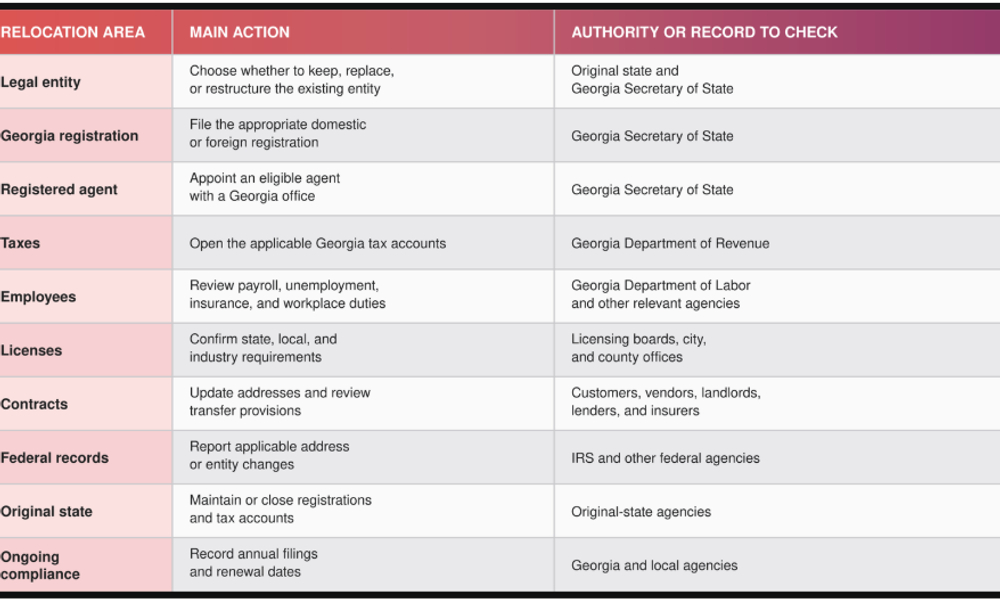
Assign a responsible person and deadline to every item. Keep confirmation receipts, approved filings, account numbers, and renewal dates in one controlled record.
How Long Does It Take to Move a Business to Georgia?
Your schedule depends on the entity type, filing method, licenses, property, employees, and original-state obligations. A business with no employees and few permits may complete its administrative work faster than a regulated company that needs inspections and professional approvals.
State processing covers only part of the schedule. Contract reviews, lease negotiations, equipment moves, and customer notices may take longer than the filing. Allow extra time for missing records and agency questions.
How Can You Prepare to Move Your Business to Georgia?
Before you move your business to Georgia, decide what will happen to the existing legal entity and identify every registration, tax account, license, contract, employee record, and operating system affected by the move. Official agencies can explain their filing requirements, while an attorney and tax professional can advise you about the company’s structure and obligations.
Peach State Tech covers the companies, founders, funding conditions, and technology programs shaping Georgia’s business environment. Follow the latest Georgia technology news as you evaluate the state’s markets and resources.