

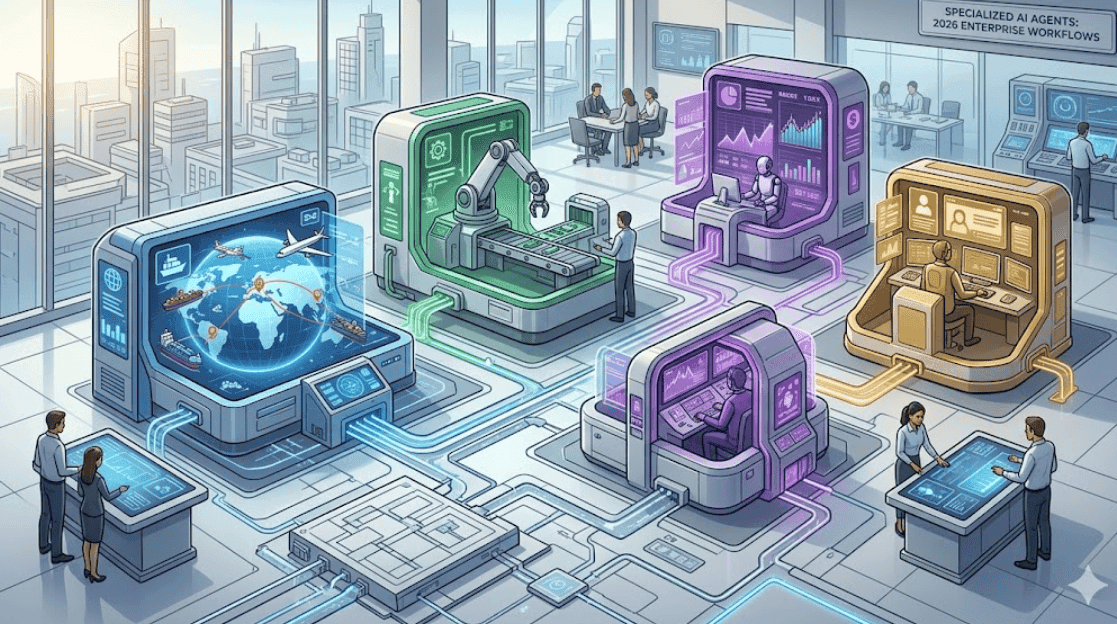
From General AI Tools to Specialized AI Agents
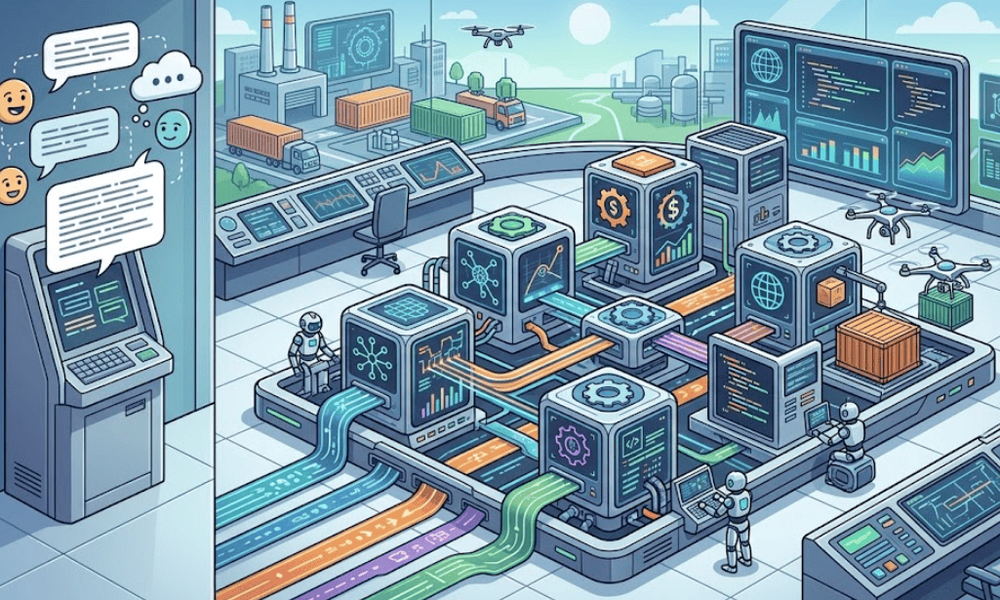
Early enterprise AI systems relied heavily on generative AI and conversational interfaces. These systems processed user inputs using natural language processing and delivered flexible responses. While useful for communication, they struggled with complex problems and structured execution inside enterprise environments. Modern specialized AI agents are built as agentic AI systems designed for execution, not just conversation. These include autonomous agents and learning agents that operate within defined types of AI agents frameworks.
Instead of responding passively, these systems evaluate context using an internal state, process current state of the environment, and determine actions based on specific goals. They function in dynamic environments, where decisions must adapt to changing inputs and real-time conditions. These systems rely on machine learning to improve performance and use a structured knowledge base to access relevant information. They also integrate with external systems such as CRMs, analytics platforms, and enterprise databases.
Common enterprise applications include:
- Customer service automation using structured customer data
- Workflow execution in software development pipelines
- Business support through AI assistant tools
- Information retrieval using tool connected to internal systems
- Decision support based on relevant information from enterprise data
Which Frameworks Or Platforms Are Recommended For Building Specialized AI Agents?
Enterprises building specialized AI agents rely on structured frameworks that support scalability, integration, and reliable execution. These frameworks allow systems to connect with external systems, process user inputs, and coordinate actions across workflows. Most platforms support agentic AI development by combining machine learning, orchestration tools, and API connectivity. This structure allows AI agents to move beyond basic responses and perform specific tasks inside enterprise environments.
Common enterprise-grade approaches include:
- Frameworks that support multi-step reasoning and task execution
- Platforms that integrate with enterprise knowledge base systems
- Tools designed for workflow automation and AI assistant deployment
- Systems that enable tool use across internal and external applications
- Architectures that support both autonomous and human-guided workflows
Selection of a framework depends on the level of control required, the complexity of tasks, and the organization’s enterprise AI adoption maturity. Systems with stronger integration capabilities typically deliver higher AI ROI over time.
Why AI ROI Depends on Execution and System Design
Strong AI ROI depends on how effectively AI systems are integrated into business operations. Many organizations fail when they deploy tools without aligning them to real workflows or specific tasks. Poor execution often results in systems that cannot properly evaluate possible actions, predict future consequences, or adapt to changing current input conditions.
Successful enterprise implementations focus on measurable outcomes such as:
- Automation of repetitive tasks and simple tasks
- Faster resolution of customer questions in service systems
- Better resource allocation across departments
- Improved decision-making using structured data flows
- Reduced operational friction in complex workflows
- Stronger alignment with enterprise best practices
When these elements are missing, AI systems remain in pilot stages without scaling into full production environments.
Are There Any Challenges Or Limitations With Deploying Specialized AI Agents?
Despite strong potential, specialized AI agents introduce operational and technical challenges during deployment. Many of these issues arise when systems are applied to complex workflows without proper structure or governance. One major limitation involves inconsistent data quality, which affects how AI systems interpret current state information and make decisions. Without clean and structured data, outputs may become unreliable.
Other common challenges include:
- Difficulty aligning AI behavior with real-world specific tasks
- Over-reliance on generative AI without proper validation
- Limited transparency in decision-making processes
- Integration issues with legacy external systems
- Gaps in handling unexpected dynamic environments
- Dependence on accurate knowledge base structures
Organizations that fail to address these issues often experience weak AI ROI and stalled enterprise AI adoption. Strong governance, testing, and continuous monitoring are required to maintain system reliability.
Human Centered AI Strategy in Enterprise AI Adoption
A strong human centered AI strategy is essential for sustainable enterprise AI adoption. AI systems must support human intervention, not replace human oversight entirely. In enterprise environments, human agents continue to validate outputs, especially in high-impact decision-making processes. This ensures that AI systems remain reliable and aligned with operational expectations.
A structured human-centered approach includes:
- Mapping workflows based on real use cases and business needs
- Ensuring humans oversee outputs from autonomous systems
- Using prompt engineering to improve system accuracy
- Maintaining transparency in how AI reaches conclusions
- Aligning AI behavior with enterprise utility function objectives
- Supporting collaboration between humans and virtual assistants
This approach improves trust and reduces resistance, especially in organizations transitioning from traditional systems to AI-driven operations.
Specialized AI Agents in Real Enterprise Environments
Modern specialized AI agents operate as structured systems within enterprise architecture. They process current input, analyze context using an internal model of the world, and execute actions based on predefined logic.
Some systems include elements of reinforcement learning, allowing them to improve performance based on outcomes across different outcomes and new experiences.
More advanced systems use hierarchical agents, where multiple AI components coordinate tasks. Simpler systems may rely on simple reflex agents or simpler agents designed for narrow execution.
These agents are commonly applied in:
- Enterprise workflow automation systems
- Customer support platforms using external tools
- Data-driven decision systems using sensor data inputs
- Operational platforms managing complex tasks at scale
- AI systems interacting with social media or digital channels
What Is The Difference Between A Super-Agent And Having Multiple Specialized AI Agents?
A key design decision in modern AI architecture is whether to use a single super-agent or multiple specialized AI agents working together. A super-agent is a centralized system designed to handle a wide range of tasks. It often relies on a single large language model combined with multiple tools and instructions. While flexible, it can become complex and harder to control in large-scale enterprise AI adoption environments.
In contrast, multiple specialized agents divide responsibilities across focused systems. Each agent is designed for specific goals, such as handling customer service, processing data, or managing workflow automation.
Key differences include:
- Super-agents manage broad, complex tasks in one system
- Multi-agent systems distribute work across specialized roles
- Specialized agents improve accuracy in targeted use cases
- Multi-agent setups offer better scalability in dynamic environments
- Super-agents may reduce coordination complexity but increase internal load
- Multi-agent systems improve modular control and system reliability
Enterprise organizations often prefer multi-agent systems because they improve AI ROI, reduce operational risk, and allow better alignment with human centered AI strategy principles.
Final Perspective on Enterprise AI Adoption and AI ROI
The shift toward specialized AI agents reflects a broader transformation in enterprise AI strategy. Organizations are moving away from general-purpose tools and toward structured systems designed for execution, scalability, and measurable performance. Success in enterprise AI adoption depends on aligning AI systems with real operational workflows, maintaining strong AI ROI discipline, and applying a consistent human centered AI strategy.
As AI systems become more advanced through machine learning, knowledge base integration, and tool use, enterprises that focus on structured implementation will outperform those relying on fragmented adoption. The future of AI in business is not defined by tool access. It is defined by system design, operational alignment, and measurable business impact.
Struggling to turn AI adoption into real business value? Peach State Tech helps Georgia-based startups, founders, and tech leaders understand how emerging technologies like specialized AI agents are shaping enterprise growth and measurable ROI. Through in-depth coverage and industry insights, we connect innovation with the people and organizations driving the future of Georgia’s tech ecosystem.