


Huper Doubles Down on Cross-Platform AI with Fresh Capital
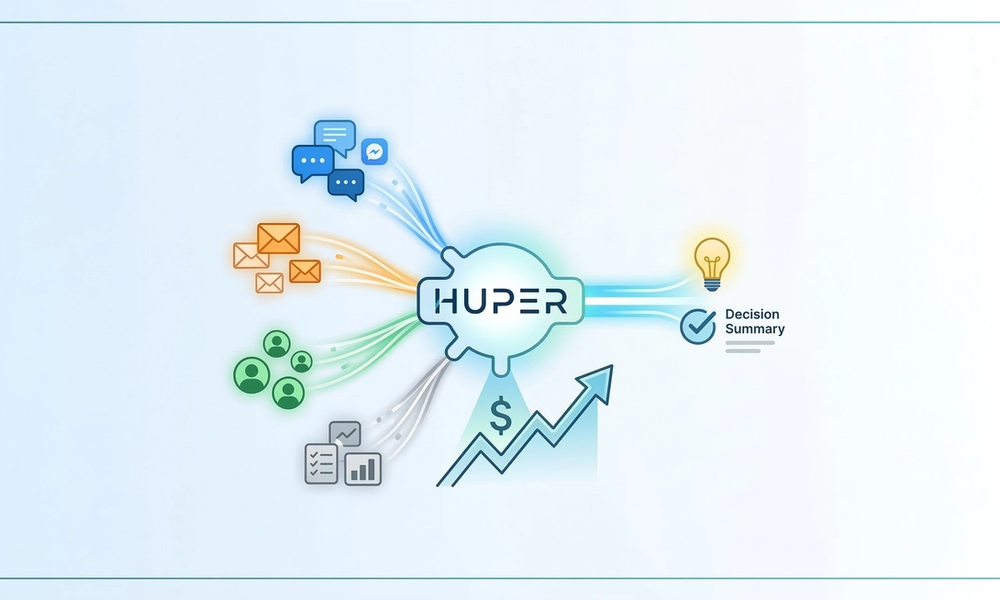
Huper, co-founded by Michael Anton, is built around the idea that leaders need clearer visibility across the systems their teams use every day. The platform pulls signals from workplace tools and turns them into operational context without adding another layer of reporting overhead.
Knowledge workers move between Slack, Teams, email, and project tools so often that important context can disappear in the process. Huper, an Atlanta startup building AI that connects conversations across those systems, has raised fresh funding to address that coordination problem more directly within the broader Georgia tech ecosystem.
Rather than replacing existing platforms, the company is building a shared layer that helps organizations follow decisions, summarize discussions, and preserve context across communication channels.
Local and National Backers See Cross-Platform Opportunity
This latest funding round suggests that investors see value in tools that organize workplace communication rather than add to it. Huper also fits into a broader Atlanta pattern: the city has already produced successful SaaS companies like SalesLoft and Pardot, helping make enterprise software a credible path for local startups. SalesLoft defined a new era for Atlanta’s tech secto by combining high-performance engineering with people-focused leadership, and that legacy still shapes how newer companies are evaluated.
That backdrop matters because Atlanta remains a practical environment for enterprise software companies. Huper enters the market from a region where startups often focus on workflow, operations, and business efficiency instead of chasing consumer-facing hype.
Beyond Simple Search: Organizational Intelligence
Huper’s product becomes easier to understand when the focus shifts from simple search to decision tracking inside day-to-day operations. This is where the company tries to separate itself from more generic AI assistants.
How Huper Turns Conversations Into Actionable Context
Huper uses language processing to index conversations and connect them to projects, stakeholders, and recurring decisions. So when someone asks, “What did the team decide on the Q3 budget?” the platform can return a sourced summary instead of forcing that person to search through separate channels manually.
How Huper helps teams work across disconnected tools:
- Pulls discussion data from communication and collaboration platforms into one searchable layer
- Connects conversations to projects, stakeholders, and decision pointsReturns summaries with source context so teams can verify where a conclusion came from
- Reduces the need to manually trace decisions across separate channels
Why Role and Hierarchy Matter in AI Summaries
That model becomes more useful when it can distinguish between routine chatter and decisions that carry organizational weight. A note from a finance leader, for example, may matter more than an informal suggestion in a side conversation, especially when teams are trying to reconstruct why a decision was made.
The same logic can also help surface contradictions early. If teams discuss conflicting approaches to the same project in different channels, Huper can flag the mismatch before those assumptions turn into duplicated work or delayed execution.
Platform-Agnostic Strategy in a Crowded Market
Huper’s market position also becomes clearer when viewed through the systems companies already use every day. Instead of asking teams to change everything, the startup is building around the reality of fragmented workplace communication.
Why Platform Neutrality Matters
Huper is entering a market where Microsoft Copilot and Slack AI already have strong visibility. Its argument is different: companies do not always need another tool inside one ecosystem; they often need a way to connect the platforms already embedded in their workflow.
That approach fits the reality of most organizations, where departments, clients, and legacy systems often leave teams working in different environments. Instead of asking businesses to standardize everything at once, Huper is trying to work within those existing habits.
That only works if the system can clean and normalize messy inputs from different tools. Huper’s processing layer is meant to handle those differences so the output is more consistent, even when the source data is fragmented or formatted in completely different ways.
Engineering Focus and Beta Expansion Plans
The next stage of the company’s growth is not just about hiring more engineers. It is also about making the product more useful in day-to-day operations, especially as Huper expands its beta efforts.
From Summaries to Active Suggestions
The new funding will largely go toward engineering growth and a faster beta rollout. That matters because Huper is trying to move beyond passive summaries and into tools that can help teams catch issues earlier and respond with better context.
The next phase centers on what the company calls “active suggestion,” which means notifying teams when a decision in one channel appears to conflict with information shared somewhere else. In practice, that requires the system to understand which people, conversations, and projects are actually connected, rather than treating every message as isolated text.
Data quality remains central to that effort. If information arrives in inconsistent formats, the summaries and alerts become less reliable, so normalization is not a side feature here; it is part of whether the product works at all.
Market Timing and Atlanta Advantage
Huper is launching at a time when many companies are reassessing the stack they built during the remote and hybrid work expansion. Businesses still rely on specialized tools, but they are also looking for ways to reduce the confusion that comes from spreading communication across too many systems.
The company expects to become publicly available later this year, and its early access efforts are aimed at Atlanta-area businesses first. That local-first rollout gives Huper a practical way to test features with companies that vary in size, workflow, and industry before expanding more broadly.
As companies plan their next round of workflow and communication investments, Huper’s pitch is simple: improve coordination across current tools instead of forcing teams to abandon the platforms that already support their work.
Curious how other Georgia tech companies are building around AI, SaaS, and enterprise growth? Read more startup coverage from Peach State Tech.