


Employee Resistance as a Core Barrier in Enterprise AI Adoption
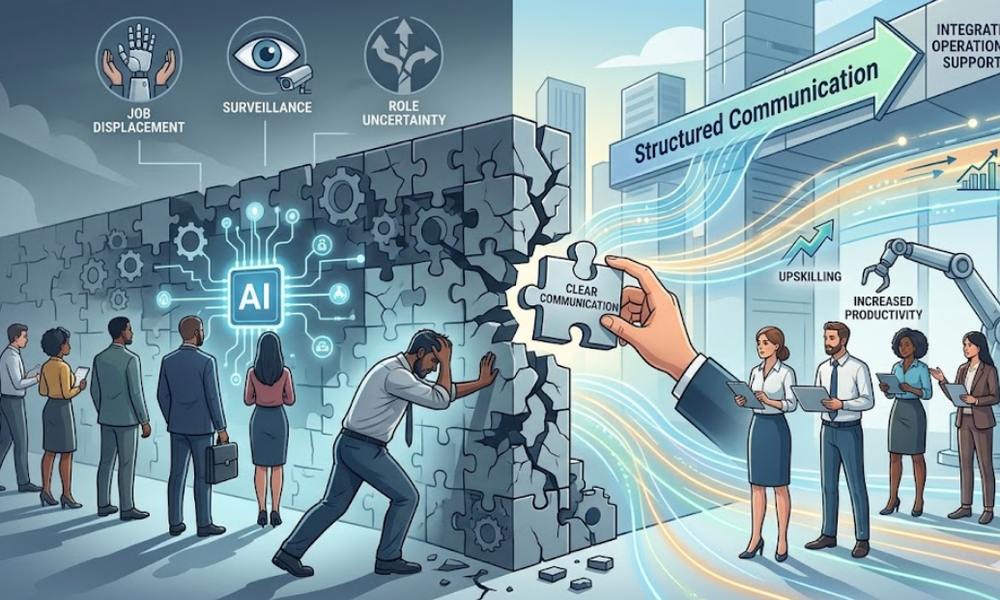
Employee resistance to AI remains one of the strongest factors affecting enterprise AI adoption challenges. Workers often interpret AI systems as tools for surveillance or job replacement rather than operational support systems designed to improve productivity. Resistance increases when organizational needs are not clearly communicated during AI initiatives. Without structured communication, employees develop uncertainty about how AI affects their roles, customer service responsibilities, and daily operations.
Key drivers of employee resistance include:
- Fear of job displacement driven by generative AI and automation systems
- Limited technical expertise in machine learning tools and predictive analytics applications
- Weak organizational alignment between business units during AI implementation
- Concerns around data privacy, security concerns, and ethical concerns in enterprise environments
These conditions reduce trust in artificial intelligence systems. Employees may avoid using AI tools, limit data input quality, or fail to report system errors. Poor participation directly impacts data quality issues and weakens real business impact across operations.
AI Change Management Strategy for Enterprise Transformation
A structured AI change management strategy plays a central role in reducing resistance and improving adoption outcomes. Enterprises that succeed in AI implementation focus on risk management, smooth integration, and organizational alignment across departments. AI change management strategy becomes essential when companies integrate AI systems into legacy systems and scalable infrastructure environments. Without structured change management, even advanced AI initiatives fail to deliver consistent business value.
Several core practices support successful AI adoption in enterprise environments:
- Transparent Communication Across Business Units Before Deployment
- Continuous Skills Development in Machine Learning and Generative AI Tools
- Mandatory Human Review of AI Outputs in Customer Service and Operations
Each practice strengthens organizational alignment and improves workforce confidence. Clear communication reduces uncertainty. Training improves technical expertise. Human oversight ensures accountability and reinforces data governance standards across enterprise data systems.
Enterprise AI Deployment Challenges in Georgia Industries
Georgia-based industries such as manufacturing, logistics, and professional services face unique enterprise AI deployment challenges due to long-term operational structures and relationship-driven business models. Many organizations operate with legacy systems that limit the integration of AI systems across departments. These technical constraints slow down smooth integration and reduce scalability across enterprise infrastructure. As a result, AI initiatives often struggle to deliver measurable business impact.
Companies that rush AI implementation without addressing organizational alignment or workforce readiness frequently experience reduced productivity. In contrast, organizations that invest in structured AI change management strategy frameworks achieve more stable adoption and stronger business outcomes. Fractional executives, including CTOs, CFOs, and COOs, increasingly focus on AI governance, risk management, and operational operating model adjustments. Their involvement ensures that AI initiatives align with business goals and organizational needs across different departments.
Deployment Challenges with Large Language Models
Large language models (LLMs) introduce complex enterprise deployment hurdles, demanding high-quality data, rigorous governance, and careful integration. While often perceived as standard software tools, LLM production environments require significantly more structural oversight.
Organizations face several primary challenges when deploying these advanced systems.
- Data quality and governance. LLMs rely heavily on enterprise data, where poor inputs inherently yield inaccurate or inconsistent outputs. Weak governance further elevates risks regarding data privacy, security, and corporate ethics.
- Legacy infrastructure integration. Many enterprises operate with outdated systems incapable of supporting the scalable computing requirements of LLMs, thereby increasing implementation complexity and slowing adoption.
- Workforce readiness. Employee resistance intensifies when these models are introduced without comprehensive training or clear communication regarding how outputs are generated and utilized for decision-making.
- Risk management and validation. The inherently unpredictable nature of LLM outputs necessitates robust, human-in-the-loop validation processes.
Structured change management frameworks are therefore essential for maintaining operational control and ensuring consistent business value throughout the deployment cycle.
Data Governance and Business Value in AI Systems
Enterprise AI success depends heavily on data governance, data quality, and enterprise data consistency. Poor data quality issues often lead to unreliable outputs from machine learning systems, generative AI tools, and predictive analytics models. Organizations with strong data governance policies improve data availability and reduce risks related to security concerns, data privacy, and ethical concerns. These improvements strengthen system reliability and increase long-term business value.
Companies that invest in structured enterprise data systems gain more value from AI initiatives compared to those relying on fragmented data sources. Strong governance ensures that AI agents and predictive analytics systems operate with accurate and consistent inputs, improving customer service and operational efficiency.
AI Integration and Organizational Alignment Across Enterprises
Successful integration of AI systems depends on organizational alignment across business units. Without alignment, AI initiatives become isolated technical projects instead of enterprise-wide transformation tools. Key challenges in integration include legacy systems, lack of scalable infrastructure, and inconsistent operating models across departments. These issues create delays in AI implementation and reduce the effectiveness of enterprise AI deployment challenges solutions.
Organizations that align business goals with AI initiatives achieve stronger business impact and improved system adoption. This alignment ensures that artificial intelligence supports real business problems rather than isolated technical use cases.
Enterprise AI Deployment Outlook in Georgia
Enterprise AI deployment challenges will continue evolving as Georgia companies expand AI initiatives across manufacturing, logistics, and service industries. Organizations that prioritize structured AI change management strategy frameworks, strong data governance, and workforce readiness will achieve more sustainable outcomes. Artificial intelligence adoption is no longer limited to technology teams. It now requires coordinated execution across business units, technical teams, and leadership structures to ensure long-term success.
Need support in aligning AI systems with real workforce readiness and long-term business value? Peach State Tech connects Georgia’s fastest-growing companies with the visibility and credibility they need to lead in today’s tech-driven economy. Through expert storytelling and industry coverage, we help innovators, founders, and teams get discovered by the people who matter most.