


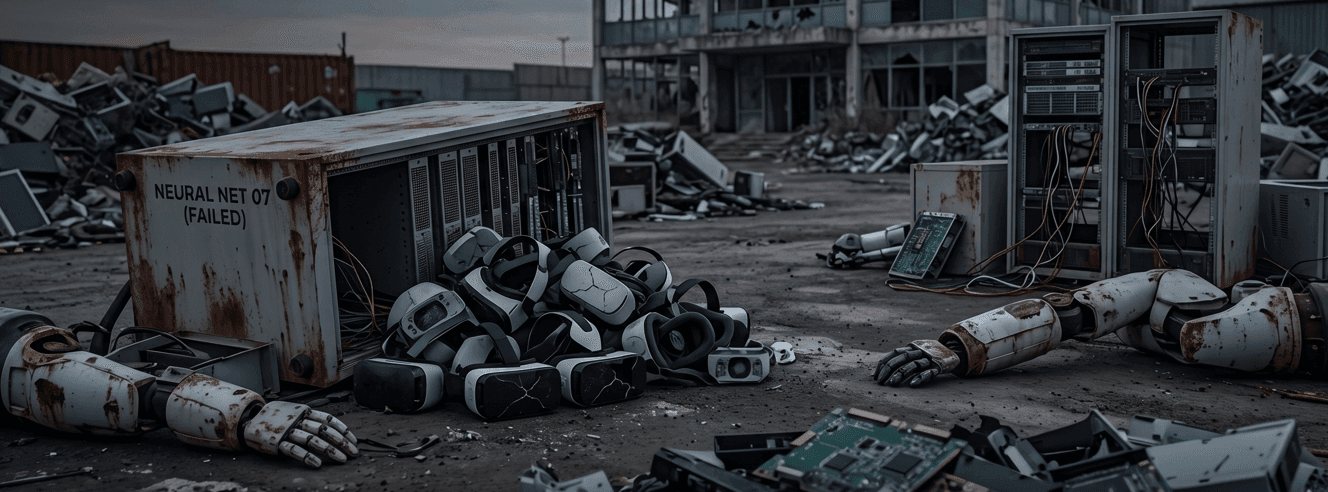
Why the AI Implementation Crisis Keeps Growing
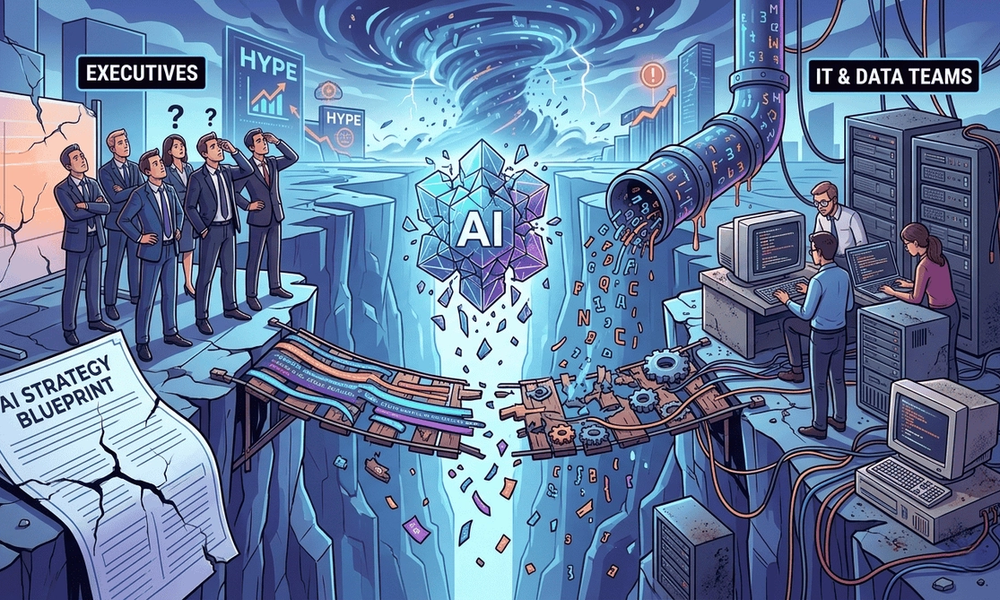
Many companies jump into AI because of hype. They want a competitive advantage or better customer experience. But they don’t have a clear AI strategy.
There is also a gap between business executives, IT teams, and data scientists. Each group has different goals. This creates confusion and slows down progress. Most companies also struggle with messy data sources, poor data quality, weak data governance, unclear business goals, and old legacy systems that don’t support AI.
Consequently, many AI initiatives launch with momentum but ultimately collapse during the execution phase. That execution gap is a primary driver behind the rising project failure rate.
The Real Reason AI Projects Fail
Building smart systems is only half the battle; making them function within a real business environment is where the actual challenge lies. Many companies focus on model development and model training. They build advanced foundation models and tools for natural language processing. But they forget how to connect AI to daily business processes.
Without proper AI integration, these systems cannot solve real business problems. AI agents need clean raw data, working software systems, and access to the right tools. Without this, even the best AI solution will fail.
AI Orchestration Makes AI Agents Work
This is where AI orchestration becomes important. AI orchestration helps AI agents connect with systems, tools, and workflows. It allows them to move from insight to action. Without it, AI agents can only give suggestions—they cannot complete specific tasks.
Proper orchestration empowers agents to move beyond making suggestions to executing tasks:
- automate repetitive tasks
- improve customer service
- support complex decision-making
- reduce labor costs and save time
- handle complex processes across systems
Without this connectivity, agents remain stuck in passive mode.
Why AI Consulting Needs to Change
The AI implementation crisis is also changing the consulting world. The era of consultants delivering theoretical reports is over; today’s businesses demand tangible, integrated results.They want AI that works inside their software development systems and daily operations.
Consultants now need to move beyond theoretical frameworks and best practices to building tangible systems that function with minimal human oversight. Modern AI is shifting from passive analysis to active execution.
People Can Still Stop AI Success
Even if the system works, people can still block success. Some employees worry about job loss. Others do not trust AI. This creates resistance inside companies. To fix this, businesses must:
- explain how AI helps, not replaces, people
- train teams to work with AI tools
- set clear roles between humans and AI agents
- align AI with real business goals
- ensure strong security measures and trust
True efficiency emerges only when human oversight aligns perfectly with automated systems.
What Does a “Crisis of Control” Mean for AI Development?
As AI agents become more advanced, they can make decisions on their own. While this autonomy offers benefits, it introduces significant operational risks if system design is neglected. Organizations often lose control when AI systems are scattered across unconnected software. Without integrated data, clear orchestration rules, and modern infrastructure, real-time action becomes impossible.
This means AI agents may work in testing but behave unpredictably in real use. Without strong control systems, businesses face unexpected outputs, security risks, broken workflows, and poor alignment with business goals.
A crisis of control makes it harder to trust AI at scale. This increases the AI project failure rate.
Why AI Agents Need Strong Control Systems
While AI agents are intelligent, their primary value lies in their ability to execute actions. However, they require strict boundaries. Without proper control, agents introduce significant risks, such as:
- Accessing incorrect or unauthorized data sources
- Misinterpreting critical business workflows
- Introducing errors into final decision-making
To prevent these issues, companies must blend AI capabilities with robust human oversight and strong system design.
How Federal Laws and Regulations Could Impact the AI Implementation Crisis
Government oversight is emerging as a force in the evolution of artificial intelligence, directly addressing the chaos of the current implementation crisis. As businesses integrate AI deeper into their operations, the lack of standardized rules has often led to reckless deployment and subsequent failure. To counter this, federal legislation is expected to introduce strict requirements that compel organizations to prioritize accountability over speed.
These laws will likely mandate rigorous standards for data governance, user privacy, and system security, effectively forcing companies to clean up messy data sources and secure their infrastructure. Additionally, the demand for AI decision transparency will require businesses to dismantle "black box" models, ensuring that every automated action can be explained and audited.
Companies can no longer afford to "move fast and break things"; instead, they must invest in comprehensive documentation and integration testing before going live. Although this adds friction to the early stages of development, it ultimately offers a solution to the implementation crisis. By ensuring that only strong, compliant systems reach production, federal regulations could significantly lower the failure rate, transforming AI from a risky experiment into a reliable, long-term business asset.
Possible Effects of AI Regulation on Businesses
Stronger regulations could slow down early AI adoption, but they may also reduce failure rates in the long term. To stay compliant, companies will likely need to:
- Document all AI use cases thoroughly
- Provide proof of safe AI integration
- Improve data quality before deployment
This adds more upfront work, but it may lead to more stable AI systems and fewer failed projects.
Overcoming the AI Implementation Crisis
To succeed with AI, companies must focus on action, not just ideas. Success requires building robust infrastructure and cleaning up data, but primarily, it depends on selecting key use cases that solve tangible problems.
AI agents are powerful, but they need the right setup to succeed. This implementation crisis serves as a critical warning. The companies that prioritize actionable strategy today will define the industry, while those that ignore the problem risk falling behind—which is exactly why the focus on execution is reshaping Georgia's mid-tier consulting industry.
Peach State Tech connects Georgia’s tech ecosystem by spotlighting the startups, founders, and innovators shaping the future of AI and digital transformation. If your organization is navigating the AI implementation crisis, we help you gain visibility and credibility through stories that highlight real innovation and impact.
Join the growing network of companies being discovered, featured, and recognized across Georgia’s fast-evolving tech landscape.