


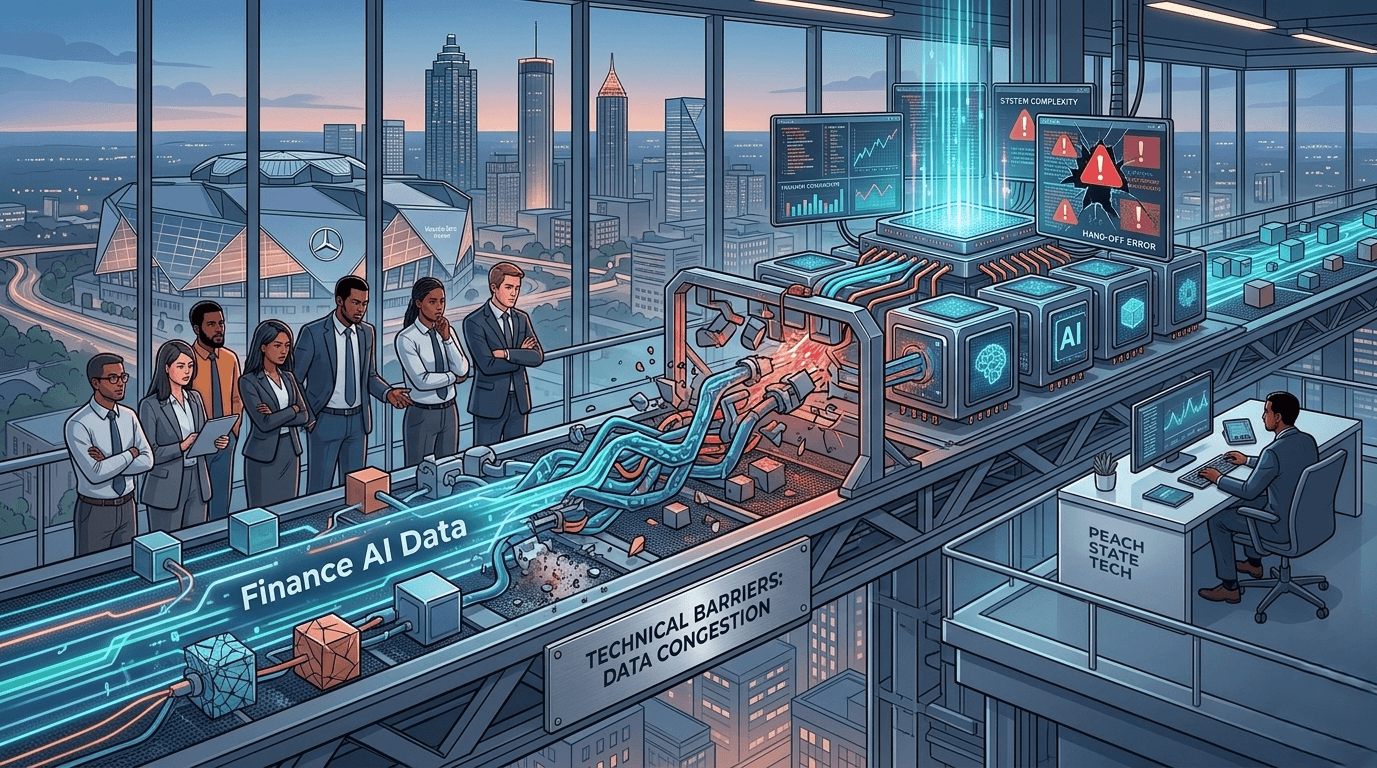
Atlanta's Finance AI Momentum Still Meets Hard Technical Limits

Atlanta has become one of the more important markets for financial technology, and that gives the region a strong foundation for AI development. Even so, product teams working in finance still face a different reality from teams building consumer AI tools. In financial environments, a weak output is not just inconvenient. It can lead to audit exposure, compliance risk, flawed reporting, or operational decisions that carry real business consequences.
That is why finance AI has not moved at the same pace as AI in marketing, customer service, or general productivity tools. The challenge is not simply whether the model can generate answers. The harder question is whether the surrounding systems can support AI in a way that is secure, traceable, and usable inside regulated workflows.
For the Georgia tech scene, three technical barriers stand out: strict data governance requirements, legacy ERP systems that limit clean data flow, and the growing need for explainable AI in regulated financial environments. Atlanta’s progress in financial technology is real, but the companies most likely to gain ground in this space will be the ones solving those foundational problems rather than treating AI as a surface-level feature.
Barrier 1: Data Residency and Data Governance Still Slow Development
One of the biggest barriers in finance AI is the handling of sensitive data. Financial systems contain customer records, account activity, internal reporting, and other information that cannot be moved or processed casually. That creates tension for product teams trying to use large AI systems that often depend on broad data access.
In practical terms, teams are often caught between two difficult options. One is to rely on cloud-based models that raise concerns about where data is processed, how it is retained, and whether sensitive information could be exposed. The other is to use more controlled internal environments that may offer stronger compliance safeguards but can be more expensive, slower to scale, and harder to maintain.
This is why controlled AI environments are becoming more important in finance. Instead of feeding raw financial data into loosely governed systems, teams are moving toward architectures that separate inference from training and create stricter boundaries around how sensitive information is accessed. That shift may reduce compliance risk, but it also increases infrastructure demands.
For companies across the Peach State, this is where AI strategy becomes an engineering issue. It is not enough to ask whether a model performs well. Teams also need to decide how data is isolated, who can access it, and how usage can be documented over time.
Barrier 2: Legacy ERP Systems Still Get in the Way
Another persistent barrier is the condition of the underlying data itself. Much of the financial information companies rely on still lives inside older ERP platforms, disconnected reporting tools, spreadsheets, PDFs, and custom internal workflows. These systems were built for recordkeeping and process control, not for AI-ready data movement.
That gap creates a major operational problem. Before AI can help with forecasting, anomaly detection, reconciliation, or financial analysis, the data first has to be extracted, standardized, cleaned, and connected. In many cases, that work takes more time and effort than building the AI feature the company wants to launch.
This is where many finance AI projects lose momentum. Product teams may begin with a clear use case, but they quickly discover that the real bottleneck sits below the model layer. If the source systems cannot deliver reliable, structured, and timely data, the AI output will remain inconsistent no matter how advanced the model appears.
Barrier 3: Explainability Is No Longer Optional
Finance AI also faces a third barrier that many other software categories can delay for longer: explainability. In a financial setting, it is rarely enough for a system to produce an answer. Teams also need to understand how that answer was reached, what inputs influenced it, and how the decision can be reviewed later.
That requirement changes the way products are built. A highly accurate model may still be difficult to deploy if it cannot provide enough visibility into its reasoning. In regulated environments, a slightly less advanced system that offers clearer auditability may be far more useful than a stronger model that operates like a black box.
This is especially important for tools that support reporting, forecasting, risk analysis, approvals, or other financially significant decisions. Product leaders have to think about more than performance benchmarks. They also have to ask whether compliance teams, auditors, and enterprise buyers can understand the system well enough to trust it.
Across the Peach State, this is one of the clearest ways finance AI differs from more experimental forms of software automation. The winning systems are likely to be the ones that can show their work, not just generate outputs quickly.
Why Atlanta Still Has an Advantage
Even with those barriers, Atlanta remains a strong market for finance AI innovation. The city’s long-standing concentration of payments, enterprise software, and financial operations talent gives local companies a meaningful advantage. Teams in the region are not approaching finance AI in isolation. They are building inside an environment shaped by transaction-heavy businesses, reporting complexity, and large-scale financial infrastructure.
That context matters because it creates a more grounded starting point. Companies operating within Atlanta’s fintech ecosystem are often closer to the real operational problems that AI needs to solve. They are dealing with fragmented systems, compliance expectations, reporting layers, and integration demands that mirror the actual conditions of enterprise finance.
For Peach State Tech, this is part of what makes Atlanta’s role in the Georgia tech scene worth watching. The region is not just producing AI interest. It is producing the conditions where more disciplined and enterprise-ready finance AI can take shape.
What Companies Need to Build First
If finance AI is going to scale more effectively, product teams need to focus on the infrastructure that makes trusted deployment possible. That includes:
- Data control: Clear policies for how sensitive financial information is accessed, processed, and protected
- Normalization layers: Systems that convert fragmented records, spreadsheets, and ERP outputs into consistent, usable inputs
- Integration architecture: Reliable pathways between source systems, reporting tools, and AI interfaces
- Auditability: Logs, traceability, and documentation that allow teams to review outputs and actions over time
- Explainability: Interfaces and model structures that make financial recommendations easier to interpret and justify
This work is not especially flashy, but it is what separates enterprise-ready finance AI from prototypes that look promising in demos and fail in production. Companies that treat these layers as core product requirements will be in a better position to move beyond experimentation.
The Next Winners in Finance AI May Be the Most Disciplined
The future of finance AI will not be decided only by who has access to the most advanced model. It will be shaped by which companies can make AI dependable within real financial systems. That means solving for governance, integration, visibility, and trust at the same time.
As more companies across the Peach State look for ways to modernize financial operations, the strongest players may be the ones that treat responsible AI infrastructure as a competitive asset rather than a backend burden.
To keep up with the forces changing Georgia’s innovation economy, turn to Peach State Tech for reporting on the ideas, companies, and market shifts influencing the state’s next chapter.