

Fortune 500 Innovation Centers in Tech Square
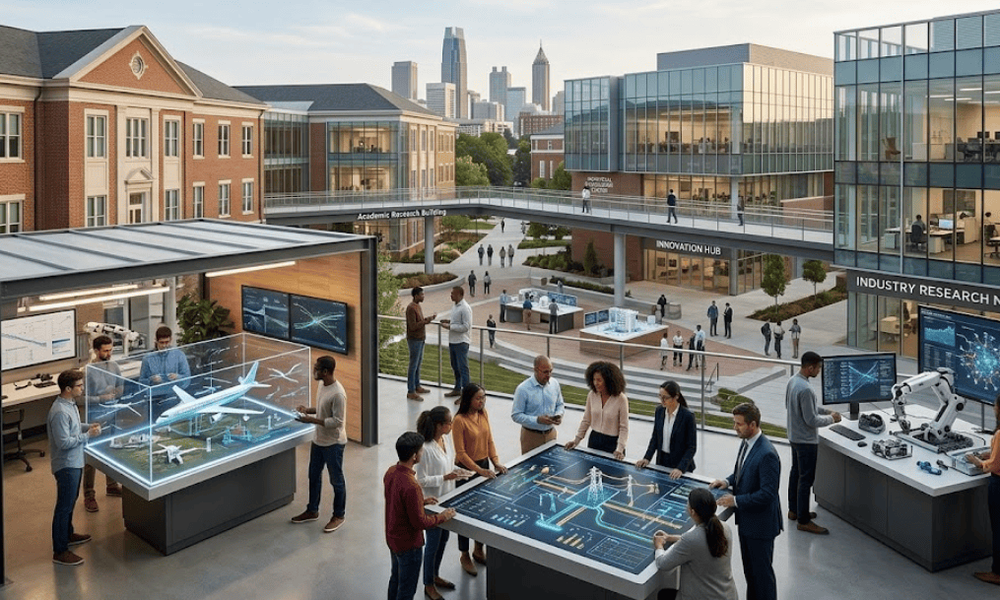
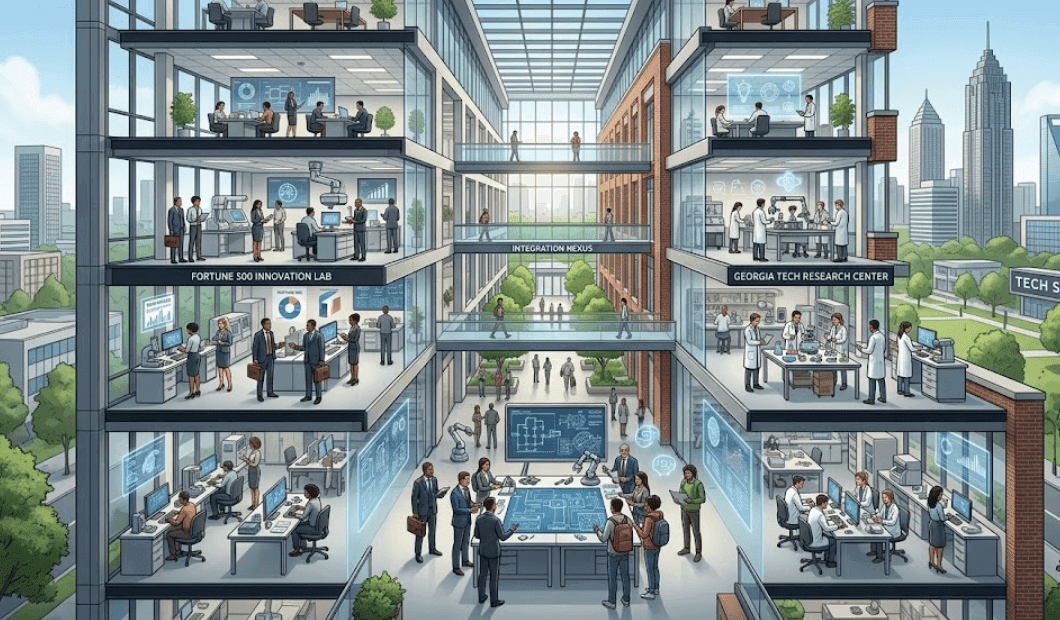
Major corporations have established dedicated innovation spaces inside Tech Square. These centers function as active research environments where industry teams work alongside academic institutions such as Georgia Tech.
Fortune 500 innovation centers in Tech Square include:
- Delta Air Lines’ The Hangar, focused on flight optimization systems and large-scale data analysis for aviation operations
- Southern Company’s Energy Innovation Center, focused on energy management systems and grid optimization technology development
- NCR Voyix innovation teams, focused on enterprise systems, applied engineering, and digital infrastructure solutions
These centers support continuous exposure to new technologies developed inside university research labs. Companies participate in research during development stages rather than waiting for completed results. This structure improves business goals by reducing delays between discovery and implementation.
How Do Embedded Corporate Labs Work With Academic Institutions?
The Tech Square model is built around embedded corporate labs, where companies and academic institutions share physical space and research resources. This setup strengthens innovation efforts by connecting business problems directly to academic research activity.
Key features of embedded corporate labs include:
- Direct Access To University Research Facilities And Laboratory Systems
- Continuous Collaboration Between Corporate Engineers And Academic Research Teams
- Early Exposure To New Technologies Before Market Deployment
- Recruitment Pathways Through Internships And Co-Op Programs
- Real-Time Application Testing In Artificial Intelligence, Robotics, And Energy Systems
This structure improves product development outcomes by aligning research activities with practical industry requirements. Companies gain early visibility into new technologies, while universities apply research directly to real operational challenges.
What Challenges Do Corporations Face When Trying To Integrate R&D Into Their Business Processes?
Corporate R&D integration introduces operational and structural challenges even for large Fortune 500 organizations. Moving research teams into academic environments requires adjustments in governance, workflow alignment, and long-term planning. These challenges affect how effectively companies convert research output into business value.
Several recurring challenges affect corporate R&D integration:
- Misalignment Between Academic Research Timelines And Corporate Delivery Targets
- Difficulty In Coordinating Cross-Functional Teams Across University And Industry Systems
- Complex Resource Allocation Between Internal R&D Units And Embedded Lab Operations
- Limited Standardization In Data Sharing, Intellectual Property, And Research Ownership
- Organizational Resistance To Decentralized Innovation Models
These challenges influence how companies design their product development process and manage resource allocation across multiple research environments. Organizations that fail to address these issues often experience delays in converting research insights into operational systems.
Effective development activities inside embedded labs require clear coordination between corporate strategy teams and academic researchers. Without structured alignment, even strong innovation efforts may produce fragmented outcomes that do not fully support business objectives or long-term technology roadmaps.
University Industry Research Partnerships in Atlanta
Atlanta has developed a segmented innovation ecosystem. Tech Square in Midtown serves as a core location for engineering and research, while other districts focus on finance, logistics, and business scaling. Georgia Tech plays a central role through university industry research partnerships Atlanta, connecting Fortune 500 companies with academic institutions working in robotics, artificial intelligence, logistics, and energy systems. These partnerships also support new technologies moving from research environments into applied industry use.
The logistics sector demonstrates strong integration. Companies such as Norfolk Southern and UPS use Tech Square facilities to test automation systems, warehouse robotics, and supply chain software in controlled environments. This reduces development time and improves alignment with market needs and operational requirements.
Expansion of Corporate R&D Integration Through Data Science
Tech Square continues to expand its infrastructure to support data science, artificial intelligence, and high-performance computing. The George P. “Bud” Peterson Building represents this next phase, focusing on large-scale computational systems and advanced research collaboration between industry and academic institutions. Companies investing in AI systems and automation platforms now treat Tech Square participation as part of long-term technology roadmaps. Access to new technologies emerging from university environments supports a stronger competitive advantage and faster implementation cycles.
Corporate R&D integration in this environment reflects a shift in business strategy. Research activity is no longer isolated within headquarters. Instead, it operates within shared ecosystems where academic research and industry application develop in parallel.
Corporate R&D Integration and the Future of Innovation Models
The Tech Square model demonstrates how innovation efforts are becoming more distributed across academic institutions and corporate environments. Fortune 500 companies are restructuring R&D operations to improve access to talent, research speed, and exposure to new technologies. This approach strengthens competitive advantage by reducing the gap between discovery and deployment. It also supports more efficient product development cycles, where research outcomes move directly into applied business systems without long delays.
Corporate R&D integration in Atlanta has established a working model for how industry and academia can operate within a shared innovation structure, supported by continuous access to new technologies and embedded research collaboration.
Peach State Tech connects Georgia’s technology ecosystem by highlighting the companies, startups, and research partnerships shaping innovation across the state. Explore how corporate R&D integration and university industry collaboration are transforming Atlanta’s tech landscape, and discover the enterprises driving real-world innovation across Georgia’s growing digital economy.