

How AI Strategy Evolution Changed Business Thinking in Atlanta

In early 2023, many tech leaders in Atlanta did not take AI seriously. They saw tools like ChatGPT as simple tools, not real business solutions. But by 2026, everything changed. Companies began rebuilding their systems around AI systems, machine learning, and generative AI.
This fast change shows a clear AI strategy evolution. Leaders moved from doubt to action. They began using AI models, large language models, and other intelligent systems as part of a structured executive AI strategy program to improve how they work.
Today, AI is not just a tool. It is part of core business operations and modern business models. It is shaping how companies compete and grow.
AI Is Now Part of Everyday Business
Before, companies used AI for small tasks like customer service or basic data analysis. Now, it plays a bigger role in business processes and daily decisions.
This change is part of a wider AI transformation and digital transformation across many industries, often supported by an executive AI strategy program that aligns teams and goals. AI helps companies work faster and make better choices.
Many businesses now use AI to:
- Improve customer experience and customer interactions
- Handle routine tasks and repetitive tasks
- Use predictive analytics and big data for smarter decisions
This is how AI-driven organizational transformation becomes real. Teams can focus on important work while AI handles the rest.
Georgia’s Smart and Practical AI Approach
Companies in Georgia focused on results, not hype. This helped speed up the adoption of AI.
They used AI to solve real problems. For example, they studied customer behavior, improved data quality, and built strong data governance systems. They also used natural language processing and computer vision to better understand data.
This simple approach helped companies build strong AI initiatives. It also improved business outcomes and customer satisfaction.
Because of this, Georgia became a strong player in using new technologies in real-world business.
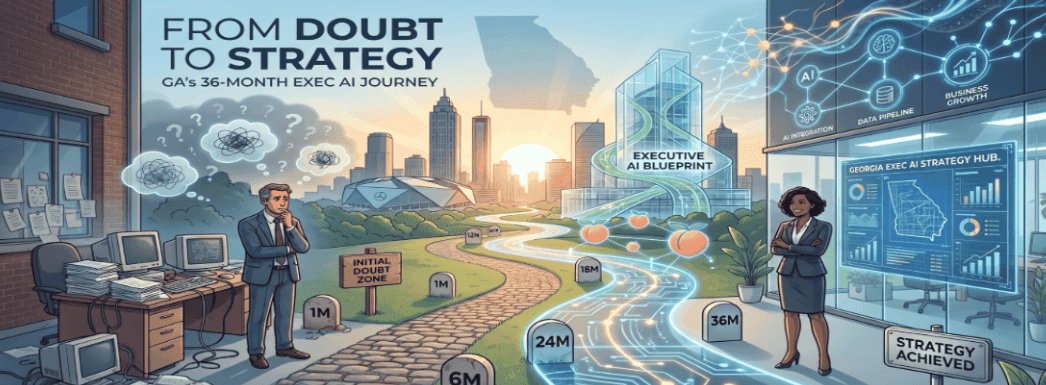
The 4 Stages of AI Strategy Evolution
Most companies in Atlanta followed the same path in their AI strategy evolution. These stages show how businesses grow with AI:
- Stage 1: Doubt (2023)
Leaders did not trust AI. They worried about risks and ethical use. - Stage 2: Testing (Late 2023)
Companies started small projects. Many failed due to poor data collection and weak systems. - Stage 3: Building (2024–2025)
Businesses improved their systems. They invested in big data, better operating models
This model shows that successful AI transformation takes time, planning, and the right tools.
Leaders and AI Now Work Together
Modern operational leadership requires the simultaneous management of human personnel and intelligent computational systems. This is a key part of AI adoption in business.
Tools like AI agents, virtual assistants, and agentic AI can handle a specific task with little help. But human expertise and human intervention are still needed.
The best companies combine human skills with AI power. This balance helps them create more business value and stay ahead of competitors.
Why This Change Matters Now
AI is shaping the future of work and driving major future trends. Companies that ignore it risk falling behind.
Businesses that adapt can:
- Improve business outcomes
- Build better business processes
- Stay competitive in a fast-changing AI landscape
This is why every company needs a clear strategic approach and strong AI vision.
How Is AI Impacting the Architecture Industry?
The architecture industry is also going through a major AI transformation. Just like in business operations, firms are using AI systems, machine learning, and generative AI to improve how they design and build.
This move is part of the larger AI strategy evolution happening across different fields. Architects are no longer relying only on manual work. Instead, they use AI to speed up design, reduce errors, and improve results.
Smarter Design and Faster Planning
Generative models and deep learning algorithms process vast datasets to rapidly simulate structural layouts and architectural variations. Using generative AI and deep learning, architects can test different layouts, materials, and structures faster than before.
This helps firms:
- Save time during early design stages
- Improve accuracy using data analysis
- Make better decisions based on predictive analytics
Better Project Outcomes with AI
AI also improves how projects are managed. With strong data governance and high data quality, teams can track progress, costs, and risks more clearly.
Tools powered by natural language processing and computer vision can review documents, detect issues, and even support contract analysis. This reduces mistakes and improves overall business outcomes.
Human Creativity Still Leads
Even with advanced intelligent systems, architecture still depends on human intelligence and creativity. AI supports the process, but architects make the final decisions.
This shows a key idea in AI-driven organizational transformation: AI works best when combined with human skills.
How Is Artificial Intelligence Expected to Evolve in the Next Few Years?
Artificial intelligence is moving fast. What we see today is only the beginning of a larger AI strategy evolution. In the next few years, AI will become more advanced, more accessible, and more deeply connected to daily business operations.
Companies will rely more on AI systems, machine learning, and large language models to guide decisions, improve workflows, and create new value. This change will continue to shape the future of AI adoption in business.
Smarter AI Systems with Less Human Input
AI tools are becoming more independent. New systems like agentic AI and AI agents can complete a specific task with minimal supervision. These tools can learn from data analysis, adapt to new inputs, and improve over time.
This means businesses can:
- Automate more routine tasks
- Reduce the need for constant human intervention
- Improve speed and efficiency across teams
Even so, human expertise will still play a key role in guiding AI and making final decisions.
Stronger Data Foundations Will Drive Growth
As AI grows, the need for clean and reliable data becomes more important. Companies will invest more in data governance, data quality, and better data collection methods.
With stronger data systems, AI can deliver:
- More accurate predictive analytics
- Better insights from big data
- Improved results across different business processes
This is a key part of building a successful AI-driven organizational transformation.
AI Will Be Part of Every Business Strategy
In the near future, AI will not be a separate tool—it will be part of every company’s strategy. Leaders will need strong strategic thinking and a clear AI vision to stay competitive.
As this happens, the line between business strategy and AI strategy will disappear. This is the next stage of executive AI strategy, where AI shapes every decision, from planning to execution.
From Doubt to Real Change
Atlanta’s story proves that AI strategy evolution is happening now. In just three years, businesses moved from doubt to full AI use. AI is more than tools like deep learning, neural networks, or image recognition. It is about changing how companies think and work. The companies that succeed are the ones that adapt early, use AI wisely, and continue to evolve.
Building something in Georgia’s fast-growing tech ecosystem? Peach State Tech helps startups and innovators gain visibility through in-depth features, founder stories, and industry insights. Get discovered by investors, collaborators, and the wider tech community.