


Venture Atlanta Targets Enterprise Procurement as Georgia Startup Survival Strategy
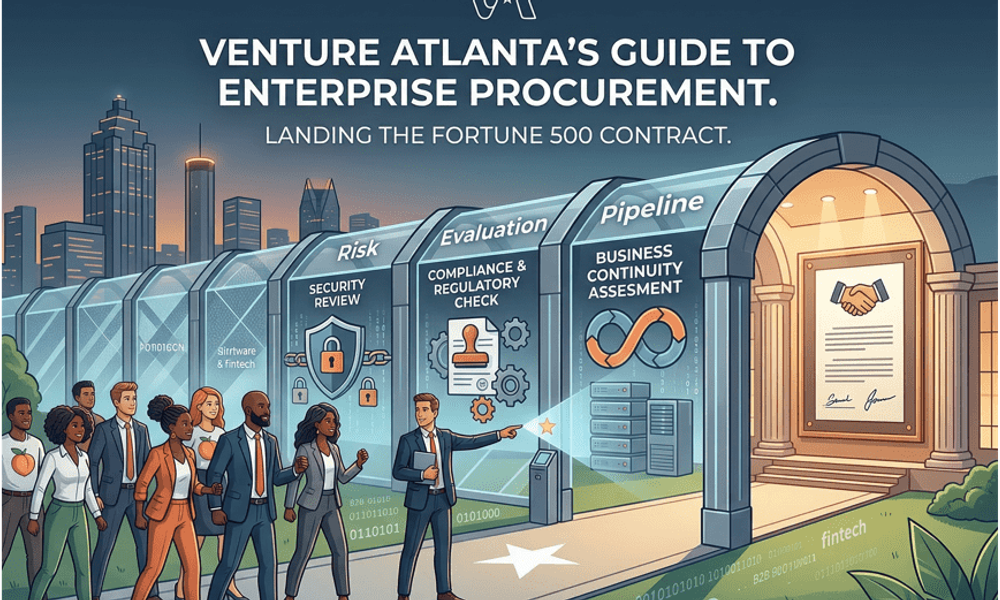
Landing a Fortune 500 contract can change the path of a Georgia startup, but getting from buyer interest to a signed agreement is often much harder than founders expect. Venture Atlanta’s latest guidance highlights a problem many young companies overlook: deals often slow down not because the product lacks value, but because procurement teams are evaluating risk at a different level.
For Atlanta’s B2B software and fintech startups, that challenge matters even more. Georgia’s proximity to major enterprise buyers creates real opportunity, but it also raises expectations around security, compliance, and business continuity.
Four Hurdles That Stall Georgia Deals for Months
Venture Atlanta’s analysis shows that many startups build strong sales momentum, only to run into resistance once procurement steps in. Internal champions may want the product, but approval still depends on whether the company can satisfy enterprise requirements.
The process usually comes down to four major reviews:
- security and IT requirements
- legal terms and contract language
- financial stability and business continuity
- diversity, compliance, and vendor documentation
Why Procurement Becomes the Real Test
This is where many founders lose momentum. Sales teams often focus on the people who want the software, while procurement is focused on whether the vendor can be trusted at scale.
That gap can be difficult for growing companies to close. A startup may show strong early traction, but still appear risky to enterprise buyers used to working with larger vendors. For Georgia companies selling into corporate environments, readiness matters almost as much as product quality.
Three Immediate Pivots for 2026 Enterprise Sales
Venture Atlanta points to a few practical adjustments that can help founders improve their chances as enterprise sales cycles grow more demanding.
What Founders Should Do Earlier
Startups can strengthen their position by:
- using investor backing and institutional relationships as credibility signals
- avoiding overreliance on small pilots that delay formal procurement
- organizing security, insurance, and recovery documents before diligence begins
- treating procurement preparation as part of sales rather than a separate admin task
These steps do not guarantee faster approvals, but they can reduce preventable friction once a deal moves beyond early enthusiasm.
Alignment with Georgia's Professional Systems Movement
This focus on procurement readiness fits a broader shift across Georgia’s business landscape. More companies are moving away from improvised growth habits and toward systems that support repeatability, accountability, and controlled scale. Companies like Nintex already provide automated governance solutions that help businesses manage complex compliance workflows.
That is why procurement carries so much weight right now. Enterprise buyers want vendors that can operate inside governed environments, not just offer promising technology. For startups, operational credibility is becoming part of the product story.
For Georgia startups, enterprise sales no longer hinge on product alone. Peach State Tech is tracking how procurement, compliance, and operational readiness are becoming core parts of growth.