


What Is the Parallel Founder Model?
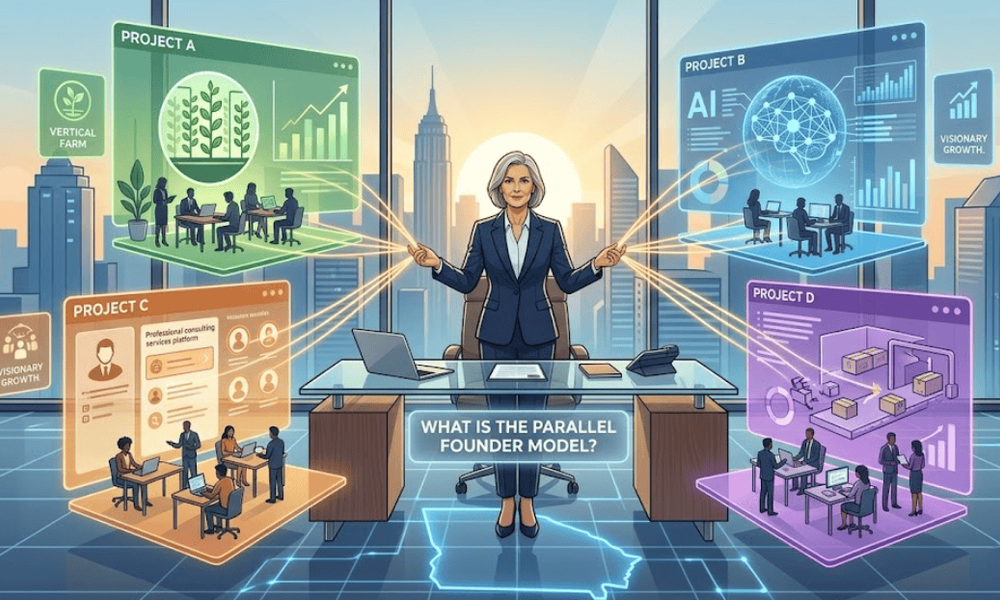
The parallel founder model occurs when an entrepreneur simultaneously builds and manages multiple startups. The founder focuses on big decisions like growth, vision, and market strategy. Each company has its own team to handle daily work. This model works best for serial entrepreneurs. These founders already have experience, so they can repeat what works across different startups.
Why the Parallel Founder Model Works in the Atlanta Startup Ecosystem
The Atlanta startup ecosystem supports shared systems and teamwork. This makes it easier to run multiple companies at once. Many startups in Atlanta also work in similar spaces, like software and tech. This allows founders to reuse ideas, tools, and strategies. The rise of the startup studio and venture studio model also helps founders launch and scale faster.
How Shared Systems Make It Work
The parallel founder model depends on strong systems. Instead of building everything from scratch, founders use shared tools and teams.
These integrated systems support multiple critical functions.
- product development across multiple startups
- daily workflows and operations
- smart tracking through analytics
- faster execution using automation
- connections to data providers through API tools
Consequently, leadership can prioritize high-level growth initiatives rather than being consumed by micro-level administrative duties. Shared systems allow founders to scale multiple startups without losing focus, maximizing the inherent power of the parallel model.
The 80/20 Rule for Managing Multiple Startups
Parallel founders follow a simple structure to stay focused. Founders allocate the majority of their operational capacity to a primary venture while systematically scaling secondary projects.
- 80% of time goes to the main startup
- 20% goes to testing or building new ideas
- new startups grow only after showing results
- each company has a team handling daily work
Maintaining this strict allocation framework preserves organizational clarity and mitigates founder fatigue.
The Role of AI in the Parallel Founder Model
The parallel founder model is growing faster because of tools powered by artificial intelligence and machine learning. These tools help founders manage multiple startups without needing to be involved in every small task. AI can handle research, track performance, and support better decisions using real-time data. Instead of relying on intuition, founders utilize comprehensive analytics to dictate cross-portfolio strategy.
It also improves workflows by automating repetitive tasks. This includes customer tracking, reporting, and even parts of product development. With strong automation systems in place, founders can focus more on growth and less on operations. As these tools continue to improve, the parallel founder model becomes easier to manage and more scalable for experienced founders.
Venture Studios and Smarter Growth
The venture studio model plays a big role in supporting the parallel founder model. It allows founders to build multiple startups using shared systems, teams, and proven processes. Rather than developing operations from the ground up, founders leverage structured environments pre-equipped with essential tools, talent, and support. This speeds up product development and reduces early-stage mistakes.
Venture studios also improve due diligence. Ideas are tested early using data, insights from data providers, and market validation. Early data validation prevents the misallocation of resources toward unviable initiatives. Many studios are backed by institutional investors, which gives startups access to funding and long-term support. With better systems and stronger backing, founders can scale multiple ventures with less risk. Consequently, the venture studio model serves as a primary driver of the parallel founder approach.
Challenges to Watch Out For
The parallel founder model offers many benefits, but it also comes with real challenges. Managing multiple startups at once can quickly become overwhelming without the right systems in place. Founders who try this model without experience often struggle. They may lose focus, delay decisions, or fail to support their teams properly. For these reasons, the framework is most effective when utilized by serial entrepreneurs with proven scaling experience.
Another challenge is execution. Even with strong ideas, poor workflows, weak automation, or lack of analytics can slow everything down. Founders must build clear systems before scaling multiple ventures. In the absence of rigorous structural frameworks, managing concurrent ventures inevitably leads to operational instability.
Why Atlanta Has an Advantage
The Atlanta startup ecosystem gives founders a strong edge when using the parallel founder model. One major advantage is lower operating costs compared to cities like San Francisco or New York. This makes it more affordable to run multiple startups at once. Atlanta also has a culture of collaboration. Founders share insights, talent, and even tools. Many companies use similar systems, including shared API integrations and access to trusted data providers, which reduces setup time.
Support from institutional investors and startup networks also helps founders scale faster. Instead of working alone, they are part of a connected system that supports growth across multiple ventures. These combined advantages position Atlanta as an optimal environment for applying the parallel founder model.
The Future of the Parallel Founder Model
The parallel founder model is becoming a key part of modern entrepreneurship. As tools powered by artificial intelligence and machine learning continue to improve, founders can manage more companies with less effort. These technologies automate routine tasks, enhance data-driven decision-making, and accelerate product development cycles, thereby minimizing the need for constant manual intervention.
At the same time, the rise of the venture studio model and startup studio systems will continue to support this approach. These structures allow founders to launch and scale startups faster while maintaining quality. In the future, more founders will move away from building just one company. Instead, they will manage a portfolio of startups, using systems and strategy to drive growth.
This framework has moved beyond the experimental phase and is establishing itself as the operational standard for experienced founders. As the Atlanta startup ecosystem continues to grow, the parallel founder model will play a key role in shaping how modern startups are built and scaled.
Peach State Tech connects Georgia’s startup ecosystem by highlighting the founders and enterprises actively defining the regional market. For professionals building or analyzing frameworks like the parallel founder model, the platform provides targeted visibility to industry leaders. Explore our enterprise coverage or submit a feature to engage directly with the state's technology sector.