



The System Was Built to Avoid Risk
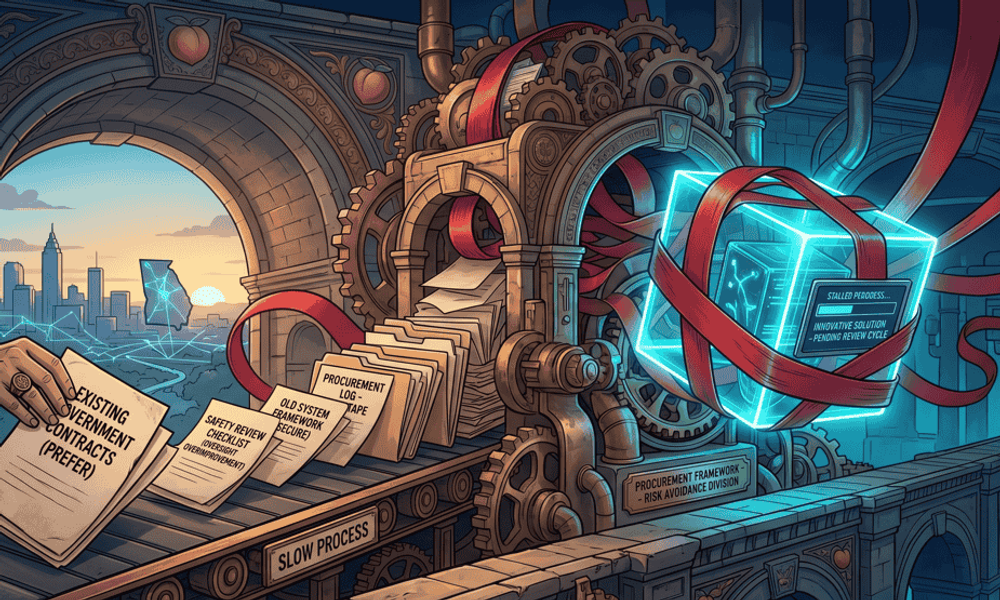
Most public sector procurement systems were designed to reduce risk, not to support innovation. Risk avoidance actively shapes how decisions are made:
- Agencies prefer existing government contracts over new ones
- Procurement professionals focus on safety instead of improvement
- Old systems stay in place because they feel more secure
Instead of supporting innovative solutions, the system depends heavily on slow administrative processes, strict rules, and red tape.
Where Innovation Breaks Down
There is a clear gap between those building solutions and those adopting them. Govtech startups are building agile AI and digital platforms to improve service delivery, while government agencies remain trapped by outdated legacy systems, long procurement cycles, and rigid contract management.
The timeline mismatch creates immediate friction. A modern technology vendor might develop and test a new feature in a matter of weeks. Meanwhile, the public sector agency evaluating that same feature operates on multi-year budget cycles and relies on complex Request for Proposal (RFP) processes.
By the time a contract is finally approved and awarded, the original technology has often evolved, forcing the agency to implement an already-dated solution. The startup runs out of financial runway waiting for the contract to clear, and the agency misses out on critical public safety or infrastructure upgrades.
When Working Technology Still Gets Rejected
For example, a government agency recently deployed a system focused on public safety technology. It tracked health data and location in real time. The system worked. It improved service delivery and gave useful insights. But it was still removed.
Why?
- Funding was reversed
- Internal support was weak
- It did not align with existing business objectives
- It did not fit current administrative processes
What followed was a long dispute that cost taxpayer dollars, even though the system had already proven its value.
Read the full breakdown of this case study: The Talitrix Case Reveals Government Innovation Gap
Institutional resistance to change and poor risk management clearly block even successful solutions.
The Real Cost of Resistance
Public sector innovation discussions often focus on systems and budgets, ignoring the broader downstream impacts. In areas like public safety and social services, failure to adopt better tools affects real outcomes. It slows progress, wastes valuable resources, and limits growth.
It also affects:
- Economic growth and local economies
- Access to better value, better solutions, and better products
- The ability of governments to deliver modern services
Why Government Procurement Innovation Falls Short
The issue is not a lack of ideas. It is a system that treats change as a risk. To adopt something new, agencies must adjust strategic activities, manage regulatory changes, and move away from routine tasks. Each step adds friction.
Agencies actively avoid change, causing government procurement innovation to continually lag. The system does not support a real culture of innovation.
How Governments Are Trying to Fix Procurement Innovation
Some governments are already testing new ways to improve public procurement and reduce delays in government technology adoption.
One example is the Procurement Innovation Lab (PIL) under the Department of Homeland Security. This program focuses on improving the procurement cycle by making it faster, more flexible, and easier for vendors to engage with.
Instead of relying on long and rigid processes, PIL encourages earlier communication between agencies and suppliers. It promotes faster proposal reviews and reduces unnecessary red tape that often slows innovation. These changes are designed to support innovative suppliers, especially smaller businesses that often struggle to enter government markets.
The PIL program proves that modernization is possible. However, adoption of these approaches is still limited across many agencies.
What Other Countries Are Doing Differently
Some countries have taken stronger steps to modernize public sector procurement and support long-term innovation.
For example, the Government Digital Service has transformed how government contracts are managed by using centralized digital platforms. Centralized platforms make it easier for agencies to work with new vendors and reduce delays in decision-making. At the same time, the European Commission has introduced policies that promote early-stage innovation through pre-commercial procurement.
In countries like Estonia, digital transformation is built into the core of public administration. Estonia designed its digital infrastructure to support faster service delivery, encourage competition, and align procurement with broader economic growth goals.
Compared to global models, many systems in the United States still depend on older structures and slower administrative processes, which makes innovation harder to scale.
How eProcurement Is Changing Government Purchasing
The rise of digital platforms is beginning to reshape how governments handle purchasing and vendor relationships.
eProcurement systems allow agencies to manage the entire procurement cycle more efficiently. They improve contract management, increase transparency, and give decision-makers better access to data. Upgrading to digital platforms leads to more consistent and effective service delivery.
Still, new software cannot overcome a broken procurement culture. Without changes in structure and mindset, even advanced systems will struggle against bureaucratic inefficiency and ongoing institutional resistance to change.
Tools That Can Support Innovation in Local Government Contracting
Improving local government procurement relies heavily on how agencies plan, coordinate, and execute their projects.
Stronger results often begin with better identification of needs and clearer alignment with agency business objectives. When procurement is tied to a defined business model, it becomes easier to evaluate solutions and measure outcomes. Adopting proven best practices and investing in the development of procurement professionals can also help agencies move beyond routine tasks and focus on more strategic activities.
In practice, successful local government contracting requires:
- Better identification of needs before procurement begins
- Clear alignment between procurement decisions and business objectives
- Stronger training and support for procurement professionals
- Use of proven best practices to guide decision-making
- Focus on long-term strategic activities instead of routine tasks
Real-world cases show what happens when these elements are missing. In one U.S. county deployment involving a company called Talitrix, a biometric monitoring system was fully operational and delivering results in a correctional setting. The technology improved visibility and supported better decision-making. However, gaps in coordination, limited internal alignment, and breakdowns in execution prevented the system from being sustained.
The Talitrix deployment reflects a broader, systemic issue. Even when innovative solutions are available and working, they can still fail if the surrounding system is not prepared to support them.
Sustaining innovation demands a fundamental cultural shift, not just the adoption of new digital tools.
Why These Changes Still Aren’t Enough
Many systems are still built around risk avoidance, slow decision-making, and the protection of existing vendors. These conditions make it difficult for new ideas to take hold, even when they offer clear benefits. To adopt something new, agencies must adjust strategic activities, manage regulatory changes, and move away from routine tasks. Each step adds friction.
Procurement officers operate in an environment heavily focused on compliance and public scrutiny. A failed technology implementation often leads to audits, negative headlines, or political blowback. Conversely, successfully deploying a new, highly efficient tool rarely results in career advancement or financial reward for the civil servants driving the project.
When the bureaucratic penalty for failure is incredibly high, and the reward for success is non-existent, the safest career choice is to maintain the status quo. Renewing a decades-old contract with a massive legacy vendor will always feel safer than taking a chance on a cutting-edge startup.
Agencies actively avoid change, causing government procurement innovation to continually lag. The system effectively punishes risk-taking, making a real culture of innovation almost impossible to sustain.
What Needs to Change
If governments want progress, they must rethink how they see risk. Trying something new should not be the biggest concern. Staying with outdated systems may be the bigger risk. To move forward, agencies need better identification of needs, alignment with their business model, and a focus on future growth. They must also adopt best practices, support innovative suppliers, and open the door to new processes.
The core problem is not a lack of innovation; it is a rigid procurement system that rejects working technology. And until that changes, the gap between what is possible and what is used will keep growing.
The gap between innovation and adoption in government is fundamentally a visibility problem. Across Georgia’s growing tech ecosystem, Peach State Tech documents how these challenges play out in real projects, companies, and public sector decisions. Understanding that the bigger picture is often the first step toward changing how innovation actually gets implemented.