


Georgia Companies with AI Training See 2.3x Faster Tool Adoption
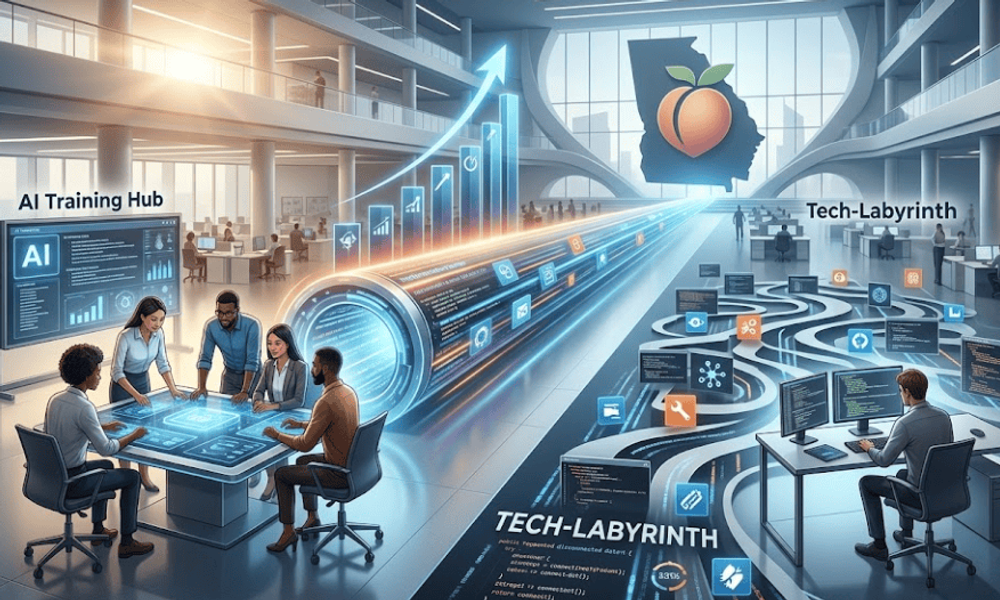
A new report published by My Mobile Lyfe reveals a major gap in Georgia's corporate AI adoption efforts. Companies with structured AI training programs achieve implementation rates that are 2.3 times faster than organizations that leave employees to learn artificial intelligence tools on their own. Meanwhile, 42% of workers report having to master these technologies without formal guidance.
The findings highlight a growing challenge for organizations investing in AI technologies but failing to develop the workforce skills needed to support successful implementation. Many companies purchase access to platforms such as ChatGPT and Claude and expect immediate results. Without a structured learning process, employees often struggle to integrate these tools into their daily work.
As generative AI becomes more common in business operations, organizations across Georgia are discovering that successful AI adoption requires more than software licenses. Many companies exploring AI consulting Georgia services are finding that workforce training and implementation planning are just as important as technology selection.
The Hidden Risks of Self-Taught AI Users
When employees are left to learn AI independently, organizations face risks that extend beyond reduced productivity. Self-directed learning often leads to inconsistent practices, security concerns, and unreliable outputs that can affect business operations. Many employees learn through trial and error, which can create gaps in knowledge and increase operational risk.
Organizations lacking formal training programs frequently encounter several severe operational challenges.
- Employees use personal AI accounts for work-related tasks involving sensitive information.
- Teams develop inconsistent workflows and prompting methods.
- Employees rely on AI outputs without proper verification.
- Staff members demonstrate limited understanding of compliance, governance, and data privacy requirements.
Such operational inconsistencies rapidly reduce enterprise trust in AI tools and limit their overall business value. Without a structured foundation, even advanced technologies may fail to deliver tangible results.
Why AI Training Programs Drive Better Results
Organizations that invest in AI training programs often see measurable improvements in adoption rates, employee confidence, and operational efficiency. Well-designed programs help employees understand how AI supports daily work while contributing to broader business strategy objectives.
My Mobile Lyfe, an Atlanta-based digital marketing and AI strategy agency, recommends developing internal AI champions who can guide teams through department-specific applications. Such targeted mentorship helps employees move beyond theory and apply AI directly to their daily responsibilities.
Effective training focuses on real-world practical applications rather than general concepts. Employees are more likely to use AI tools consistently when they understand how those tools support their responsibilities and help achieve department and company objectives.
The effectiveness of localized training stems directly from its strict focus on practical implementation. Employees learn how AI supports existing workflows instead of trying to adapt generic lessons to specialized business functions. Accounting teams, marketing departments, sales groups, and professional services firms often use AI in very different ways. Tailored training helps each team gain the skills most relevant to its work.
How Structured Training Accelerates AI Adoption
The report found that organizations with formal training initiatives experience substantially faster AI adoption than those relying on self-directed learning. Companies that provide structured guidance create clear pathways for employees to use AI effectively and responsibly.
Several factors contribute to stronger adoption outcomes. Successful organizations establish clear implementation frameworks that connect AI tools to specific business goals. They also provide ongoing learning opportunities that reinforce knowledge over time and help employees adapt to new developments. Department-specific training ensures that teams understand how AI supports their actual workflows, while internal support systems encourage collaboration and knowledge sharing across the organization.
Establishing a formal implementation framework reduces uncertainty and helps employees build confidence as they integrate AI into daily operations. Organizations benefit from higher engagement levels, improved operational efficiency, and stronger returns on technology investments.
The Rise of Just-in-Time AI Learning
Many Georgia businesses are moving away from traditional training models in favor of more flexible educational approaches. These efforts often support broader digital transformation initiatives that require employees to adapt to new technologies and workflows.
Instead of relying on lengthy certification programs, organizations are implementing short learning modules designed to solve immediate workplace challenges. Employees receive targeted instruction when they need it, which helps them apply new skills more quickly and effectively.
Modular educational models align perfectly with the rapid pace of AI development. Organizations can update training materials as tools evolve and ensure employees remain current with best practices. The most successful AI training programs combine foundational education with ongoing micro-learning opportunities that reinforce knowledge over time.
What Georgia Business Leaders Should Do Next
As AI adoption continues to expand, Georgia business leaders face an important decision. Organizations can either rely on employees to navigate AI independently or invest in structured systems that support long-term success.
Companies that prioritize workforce development position themselves to gain a competitive edge. Structured training enables teams to adopt AI responsibly while improving productivity, decision-making, and organizational performance.
Growing demand for artificial intelligence consulting services across Georgia reflects the enterprise need for expert guidance during implementation. Many organizations recognize that purchasing software alone does not guarantee success. Effective adoption requires planning, workforce preparation, and ongoing support.
Demand for AI consulting for businesses Atlantacontinues to increase as organizations seek assistance with training, governance, implementation, and workforce readiness. Many companies are turning to AI consulting services to align workforce development efforts with operational objectives and long-term business strategy.
Primary Industries Benefiting From AI Consulting
Organizations across Atlanta are using AI to improve productivity, reduce manual work, and support better decision-making. While AI can benefit businesses of all sizes, several industries are seeing stronger results because they rely heavily on data, process management, and operational efficiency.
Several specific sectors currently lead AI adoption efforts across the region.
- Marketing teams use AI to improve campaign planning, audience targeting, content creation, and performance analysis.
- Professional services firms use AI to automate administrative tasks, improve workflow efficiency, and allow staff to focus on higher-value client work.
- Manufacturing organizations apply AI to forecasting, quality control, production planning, and process optimization.
- Healthcare providers use AI to support documentation, scheduling, data analysis, and operational efficiency.
Many of these organizations discover that technology alone does not guarantee success. Companies that combine AI consulting services with structured AI training programs are often better prepared to achieve sustainable AI adoption. Employee education helps teams understand how AI supports daily operations while reducing implementation challenges.
As AI continues to expand across Georgia's business landscape, organizations that invest in both workforce development and technology implementation are more likely to achieve measurable business outcomes.
Selecting an AI Consulting Partner in Atlanta
Organizations evaluating AI consulting for businesses Atlanta should focus on providers that offer more than technical implementation. Successful AI projects require alignment between technology, workforce readiness, and business objectives.
An experienced AI consulting company should help organizations identify practical applications that support specific business goals. Consulting teams should also provide guidance on governance, training, implementation planning, and ongoing optimization. These services help organizations avoid common adoption challenges while improving long-term outcomes.
Many companies seek AI consulting Georgia services after discovering that software deployment alone does not create lasting value. Employees need clear processes, training, and support to use AI effectively within existing workflows. Organizations should look for providers with experience across multiple industries and a proven ability to connect AI initiatives with measurable business results. A structured approach helps businesses reduce risk while building the foundation for long-term growth and operational efficiency.
AI Success Requires More Than Technology
The findings from My Mobile Lyfe's research reinforce a key lesson for organizations across Georgia. Successful AI adoption depends on people as much as technology. Organizations that invest in comprehensive AI training programs create the foundation needed for faster implementation, stronger adoption rates, and sustainable growth. Effective training helps employees generate actionable insights, apply AI tools responsibly, and contribute to better business outcomes.
As AI becomes an essential part of modern business operations, structured training is becoming a critical requirement. Organizations that connect AI education with business goals, workforce readiness, and operational execution will be better positioned to compete in an increasingly AI-driven business landscape.
Following Georgia's AI Transformation? Peach State Tech covers the startups, business leaders, and emerging technologies shaping Georgia's digital economy. Explore more insights on AI adoption, workforce development, and innovation trends across Atlanta and the broader Georgia technology ecosystem.