



Artemis II Mission Marks Historic First Crewed Flight
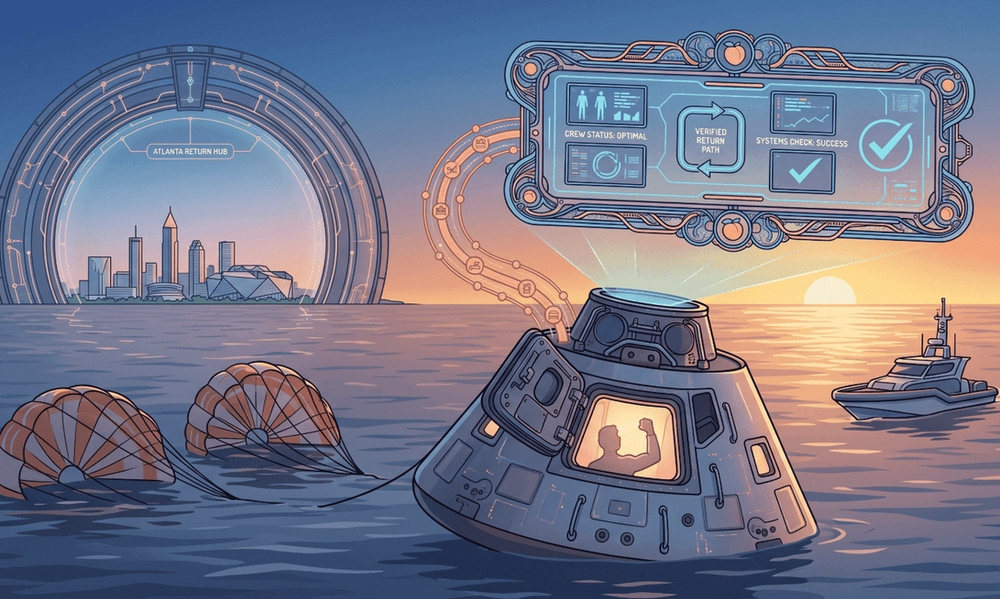
Artemis II Marks Historic First Crewed Flight
The flight safely ended with a splashdown in the Pacific Ocean. This mission was the first crewed flight of the Orion spacecraft in over 50 years to travel beyond Earth and return. The mission lifted off from the Kennedy Space Center launch pad using the Space Launch System (SLS rocket), NASA’s most powerful launch vehicle, with support from the launch control center.
The crew included Commander Reid Wiseman, Victor Glover—the first person of color on a lunar mission, and Canadian Space Agency astronaut Jeremy Hansen, along with other crew members. Strong teamwork between international partners and agencies drove NASA’s Artemis efforts throughout the flight. The Orion spacecraft, built by Lockheed Martin and also known as the Orion capsule and originally developed as a crew exploration vehicle, protected the crew during reentry using its advanced heat shield. The reentry gave NASA one of its clearest signs yet that Orion can safely support future Artemis missions farther into deep space.
For NASA, the flight was more than a test mission. It was a chance to prove Orion could support future lunar landing missions with astronauts onboard. Engineers also used the flight to evaluate orbital maneuvering needed for future journeys toward lunar orbit.
Georgia Aerospace Industry Supports NASA’s Artemis Program
Georgia-based aerospace companies continue contributing components and technical support for NASA’s expanding Artemis efforts. While the launch happened in Florida, much of the work behind the scenes takes place in different parts of the United States, including Georgia. Many aerospace companies help build and test parts of the Orion spacecraft, including the crew module and service systems. Crew safety and mission success depend entirely on the reliability of these components.
These efforts also support hardware connected to the core stage, upper stage, and solid rocket boosters used during launch.
NASA facilities like the Johnson Space Center and systems like exploration ground systems and mission control also support these missions from the ground.
Georgia supports NASA’s Artemis efforts by:
- Manufacturing parts for the space launch system and spacecraft
- Supporting life support systems and crew safety technology
- Assisting with research tied to uncrewed Artemis and future missions
- Working with NASA teams during mission planning and testing
Modern space missions rely on thousands of engineers, suppliers, researchers, and flight teams working across multiple states and partner organizations. The Artemis program also works closely with commercial partners such as Blue Origin and initiatives like Commercial Lunar Payload Services.
Orion Spacecraft Proves It Can Handle Deep Space
During the flight, Orion handled conditions far beyond low Earth orbit while carrying astronauts for the first time in decades. It traveled far beyond low Earth orbit and completed a smooth return to Earth. The flight traveled farther than missions operating near the International Space Station or the Hubble Space Telescope.
During the mission, astronauts tested key systems while moving through lunar orbit. They also worked closely with mission control to track progress and ensure safety.
The crew tested several critical systems during the flight, including:
- Crew module safety and performance
- Navigation during a lunar flyby
- Communication systems for deep space
- Heat shield protection during reentry
- Coordination with ground systems, like exploration ground systems
With the mission completed safely, NASA now has stronger confidence in Orion’s ability to support future lunar surface operations. Future missions may also support systems like the lunar terrain vehicle and the human landing system.
Artemis III Mission Will Land Humans on the Lunar Surface
After the successful splashdown, NASA officials confirmed preparations are continuing for the Artemis III mission. Artemis III will be the first mission in the program to land humans on the lunar surface. The mission builds on earlier steps, including uncrewed Artemis missions and test flights. It will also involve new technologies and partnerships.
The Artemis program also continues expanding its partnerships with international agencies, including the Japan Aerospace Exploration Agency.
NASA continues to grow its program since the establishment of the Artemis initiative. With support from agencies like the Federal Aviation Administration, the mission planning process remains focused on safety and success. Unlike older missions like Apollo 13, Artemis missions are designed for long-term goals. NASA’s long-term focus now extends beyond short visits to the Moon and toward building systems that can support sustained human activity in space.
These long-term plans differ from older systems such as the space shuttle and canceled concepts like Ares V.
What Training Did the Artemis II Crew Complete?
Before the Artemis II mission, the crew went through years of training. Years of rigorous preparation help the astronauts handle real mission conditions in deep space. Astronauts trained at NASA centers like the Johnson Space Center, where they practiced working with mission control and handling emergencies.
Training also included launch simulations connected to launch complex operations and emergency recovery procedures. Their training included:
- Simulations of launch, flight, and reentry
- Practice with life support systems and spacecraft controls
- Team coordination during crew operations
- Emergency response drills and safety procedures
The crew also trained for working in zero gravity and learned how to manage long-duration space travel. Comprehensive zero-gravity and long-duration management training ensures the crew is ready for both Artemis II and future missions.
How Is the European Space Agency Supporting Artemis II Mission?
The European Space Agency plays an important role in the Artemis II mission. One of its biggest contributions is the European service module, which is part of NASA’s Orion spacecraft and broader National Aeronautics and Space Administration partnerships.
The module powers and supports the spacecraft throughout the flight. It provides:
- Electricity for onboard systems
- Water and air for the crew
- Temperature control for safe travel
The partnership reflects how modern lunar missions increasingly depend on shared technology and international coordination. These efforts could eventually contribute to future projects such as the International Lunar Research Station.
What Happens After the Artemis II Crew Returns?
After the Artemis II mission ends with a splashdown, the crew will go through recovery and review steps. First, recovery teams will bring the astronauts safely back to land from the Pacific Ocean. Then, NASA teams will begin studying data from the mission.
Over the coming weeks, NASA engineers will continue reviewing flight data and sharing updates from the recovery process. After returning, the crew will:
- Undergo medical checks to ensure their health
- Share feedback about the mission and spacecraft
- Help engineers review system performance
- Support planning for the Artemis III mission
NASA will also study how Orion performed during reentry and flight. Post-flight data analysis is critical for improving future missions. Careful recovery and data review help NASA prepare for landing humans on the Moon and building long-term systems.
Artemis II Mission Builds the Future of Space Exploration
Artemis missions continue to inspire scientific communities, including publications like Scientific American, because of their importance to future lunar exploration.
The mission showed that NASA’s Artemis systems are getting closer to supporting regular human missions beyond Earth orbit. From launch to recovery, the mission tested how multiple systems, teams, and support operations performed together under real flight conditions. Orion, powered by the Space Launch System, proved it can carry humans safely through deep space. Support from teams across the United States, including the Georgia aerospace industry, made this mission possible.
Artemis II represents a broader shift in NASA’s strategy, moving from short-term missions toward long-duration exploration beyond Earth. The long-term goal is no longer simply reaching deep space again, but building the systems needed to remain there.
Want to stay connected to the companies powering missions like the Artemis II mission? Peach State Tech spotlights the founders, startups, and innovators driving the Georgia aerospace industry and beyond. Get your company featured and connect with the people shaping Georgia’s tech future.