


Which Georgia Entrepreneur Resources Serve Founders Outside Atlanta?
Georgia entrepreneurs can connect beyond Atlanta through statewide organizations and regional startup communities. ATDC works with technology startups across Georgia, while the UGA Small Business Development Center advises small businesses through 17 offices. Founders can also use regional resources in Savannah, Augusta, Columbus, and Macon.
For comparison, our Atlanta tech districts guide explains the capital region's startup geography.
Each organization serves a different purpose. ATDC concentrates on scalable technology companies, while the UGA SBDC supports businesses across industries. Regional hubs build local relationships. GMEN strengthens service providers, and TAG connects Georgia's technology sector.
The comparison below shows where each resource operates and how to approach it.
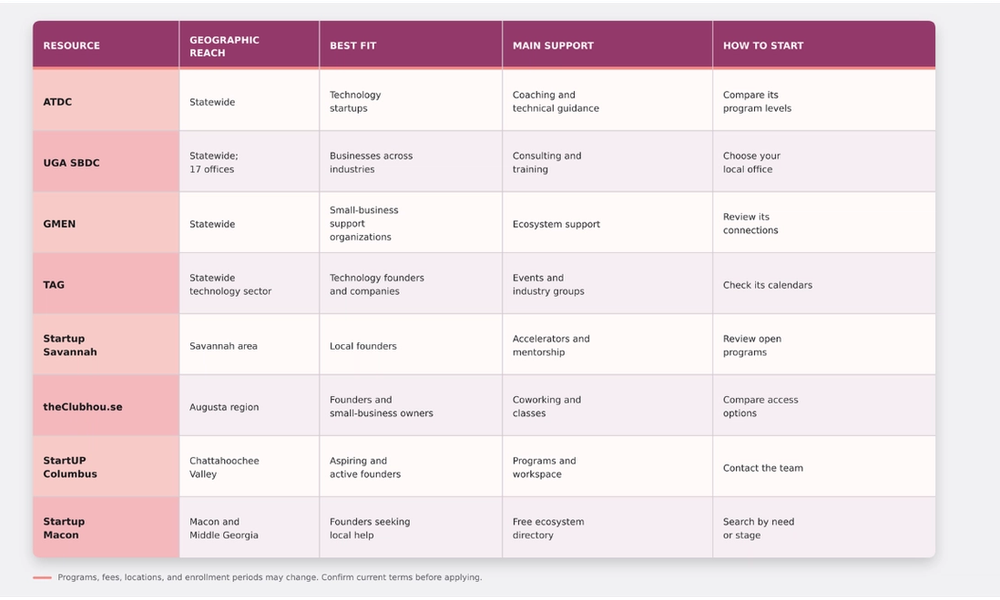
Offerings, fees, locations, and enrollment periods can change. Confirm current terms through each organization's official website before you apply or travel.
How Does ATDC Connect Technology Startups Across Georgia?
The Advanced Technology Development Center serves founders who are developing scalable technology companies in Georgia. Georgia Tech supports the incubator, which connects startups with experienced coaches and a statewide business network.
ATDC currently reports six locations across Georgia in addition to its flagship hub at Georgia Tech. Eligible founders can find a regional contact or begin through its online resources.
The company's progress determines its program level. ATDC Educate covers the idea stage. ATDC Accelerate supports founders moving from a minimum viable product toward product-market fit, while ATDC Signature works with companies preparing to scale. An online tool helps founders compare the levels.
ATDC does not take equity, according to its current website. However, participation does not give a company automatic funding. Coaches can help founders prepare and make connections, but each outside funding source makes a separate decision. Our review of Georgia venture capital trends explains the wider funding environment.
Georgia Tech VentureLab serves a narrower audience. It helps faculty members and students evaluate commercial uses for university research, while ATDC works with technology companies across Georgia.
How Can the UGA SBDC Help Entrepreneurs Near Their Communities?
The University of Georgia Small Business Development Center (UGA SBDC) gives entrepreneurs a statewide route to business advice without requiring them to join a technology incubator. The U.S. Small Business Administration (SBA) supports the network through a cooperative agreement. As an SBA resource partner, the UGA SBDC provides small business assistance through local consulting and training.
The UGA SBDC currently lists 17 offices, including locations in Albany, Augusta, Brunswick, Columbus, Macon, Rome, Savannah, Statesboro, and Valdosta. University hosts help the network combine statewide resources with regional knowledge.
A retailer may need market research, while a manufacturer may want guidance on operations. The nearest office can identify the relevant adviser or specialty program. Owners should describe their location and immediate problem when requesting assistance.
The SBDC serves a wider audience than most startup incubators. A restaurant or established family business may find a closer match there than in a program for fast-growing technology companies. Founders can still combine SBDC guidance with a local community or industry association.
Which Statewide Networks Support Georgia's Entrepreneur Ecosystem?
Statewide networks can help a founder reach people and organizations beyond one city. GMEN and TAG support different parts of Georgia’s economic development network. GMEN works with organizations that serve entrepreneurs, while TAG connects technology companies and innovators.
Georgia Micro Enterprise Network
The Georgia Micro Enterprise Network describes itself as a statewide ecosystem builder for microenterprises and small businesses. GMEN develops partnerships and strengthens the organizations that help entrepreneurs start or sustain a business. Its work includes capacity building and technical assistance. GMEN also supports efforts connected with access to capital.
An entrepreneur-support nonprofit, community lender, or program operator represents the clearest direct audience. Individual founders may still discover relevant partners through GMEN, but they should not approach the network as if it were a conventional accelerator that assigns every applicant a coach.
GMEN becomes especially relevant when a local provider needs connections across regions, including communities without a large startup district.
Technology Association of Georgia
The Technology Association of Georgia connects startups with established companies and other participants in the state's technology economy. TAG organizes industry societies and maintains a statewide event calendar. Its current chapters operate in Athens, Atlanta, and Columbus.
TAG may suit a founder who needs industry contacts or wants to follow a specialized field. Its societies cover subjects from artificial intelligence to supply chains. The association also publishes research and holds educational events.
Regional access varies with the calendar. Founders outside Atlanta should check the location and access rules for each event before joining or making travel plans.
Where Can Founders Find Regional Startup Communities Outside Atlanta?
Regional organizations can provide the repeated local contact that a statewide directory cannot replace. Savannah, Augusta, Columbus, and Macon each have a resource with a defined role in the local business community.
Startup Savannah
Startup Savannah supports technology and other local founders in the Savannah area. The organization runs community activities and intensive accelerator programs. Its current program page says the accelerators last 12 weeks and take place in person.
SPARK Savannah serves as its signature accelerator. The organization also works with the City of Savannah on LAUNCH Savannah. Graduates enter an alumni network after their cohort. Applications open during set periods, so founders should follow official notices.
Startup Savannah adopted its current name after operating as The Creative Coast. Readers should use the current name when searching for programs or contacting the organization.
theClubhou.se in Augusta
theClubhou.se combines workspace with education for Augusta's founder community. Members can use coworking areas and join regular business or technology groups. The organization also offers longer classes for people who want structured instruction.
Its Make Startups Certificate of Entrepreneurship uses 12 weeks of evening classes. theClubhou.se says participants receive a personal coach for six months.Separate membership options serve people who need workspace or ongoing community contact.
Prospective participants should compare the class and membership terms because one option may not include every program.
StartUP Columbus
Its current page lists a 10-week CO.STARTERS course. The coLAB program provides a work setting for selected early-stage ventures, while retailLAB supports retail businesses through storefront space.
The organization's address and regional mission distinguish it from startup programs in Columbus, Ohio. Georgia founders should use the startupcolga.org domain when they check current offerings.
Startup Macon
Startup Macon gives Middle Georgia entrepreneurs a searchable way to find local support. The free platform organizes resources and support organizations. People may also create voluntary profiles.
A founder can search by business need before contacting a provider. The directory covers aspiring entrepreneurs and existing owners without requiring admission to one cohort.
Startup Macon helps readers understand the local ecosystem, but a directory entry does not guarantee that a service remains open or fits every applicant. Contact the listed organization and confirm its terms before relying on a program.
How Should You Choose a Georgia Entrepreneur Network?
Your location matters, but the problem you need to solve should guide the final choice. Ask the following questions before you contact a program:
- Does the organization serve your county or region?
- Does it work with your type of business?
- Does it support your current business stage?
- Do you need an adviser, a peer community, workspace, an event, or a capital connection?
- Does access require membership, payment, or a cohort application?
- Can you participate online, or must you travel?
A founder may use several organizations without duplicating the same service. A business owner could consult the UGA SBDC about financial planning and join a regional hub for local relationships. You could meet industry contacts at a later TAG event.
Some organizations prepare founders for investor conversations, but their support does not guarantee an investment. Compare each opportunity with the company's financial needs.
How Can You Build Connections Without Traveling to Atlanta?
Founders can begin with local and online channels before committing time to a trip. The following steps can narrow the search:
- Search Startup Macon or another verified regional directory by business need.
- Contact the nearest UGA SBDC office and describe the problem you need to solve.
- Join virtual events or office hours when an organization offers them.
- Subscribe to official regional calendars and program newsletters.
- Ask a local hub to identify the appropriate statewide contact.
- Confirm eligibility and travel requirements before applying to a cohort.
Repeated participation can produce stronger relationships than one large event. You may meet an adviser who understands the market at a local workshop. A statewide event can then help you form industry connections.
Check each official program page for current dates and participation rules.
What Should You Check Before Joining a Program?
Review the eligibility rules before you prepare an application. A program may limit participation by location, company stage, industry, or years in business. The organizer should also state the meeting schedule and whether participants must attend in person. Compare fees and time requirements with the expected support. One founder may need a single consultation, while another may benefit from a longer cohort.
Read the confidentiality terms before discussing a private product. Ask whether mentors have relevant industry experience and what work the program expects from participants. Treat funding access carefully. An introduction to investors creates a conversation rather than an award. The founder must still satisfy the funder's criteria and review any financial terms.
Georgia Founders Can Build Networks Across the State
The right network depends on where your company operates and the support it needs now. Statewide organizations can provide broader expertise, while a regional hub can create sustained relationships with nearby founders and advisers.
Explore Peach State Tech's latest Georgia technology news for reporting on founders and regional innovation programs. Our coverage tracks the Georgia entrepreneur resources and business developments shaping the state's technology economy.