


The Critical Crossroads for Georgia's Tech Workforce
Georgia is at a crossroads. The tech sector is projected to add more than 8,700 new jobs in 2025—a 2.9% increase after essentially flat growth in 2024. But there's a problem: the nature of work itself is changing faster than our laws can keep up.
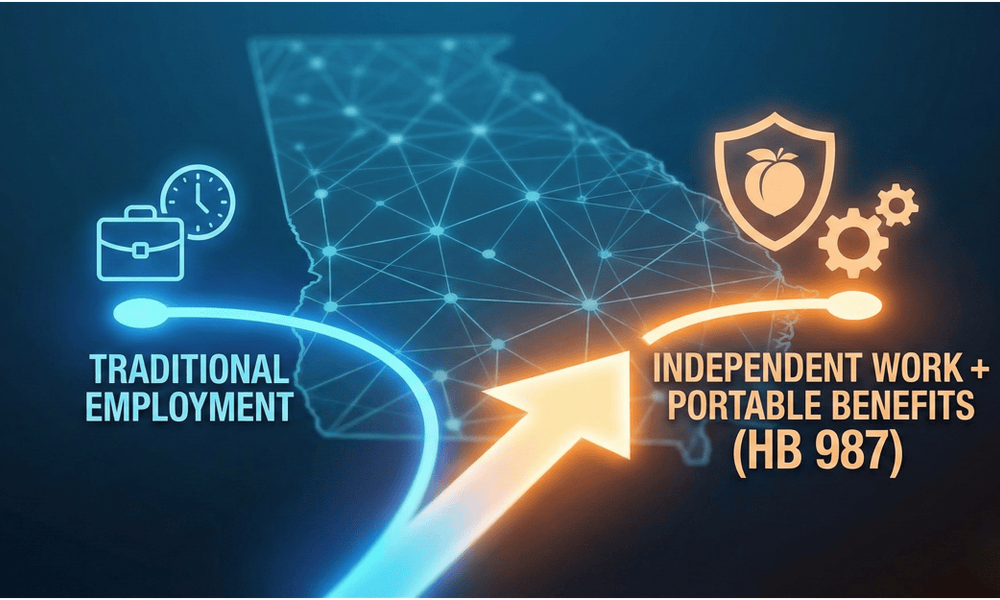
Enter House Bill 987, the "Voluntary Portable Benefit Plan Act," introduced by State Representative Todd Jones (R-South Forsyth), chairman of the House Technology and Infrastructure Innovation Committee. This isn't just another piece of legislation gathering dust in committee. It's a critical infrastructure upgrade for Georgia's 21st-century workforce—and it could determine whether the Peach State wins or loses the race for tech talent.
The Georgia Tech Workforce Is Going Independent—Fast
Here's what most people don't realize: 36% of the American workforce now freelances—that's approximately 59 million people. In Georgia specifically, self-employed workers make up 2.57% of the population, and the state ranks #7 nationwide for freelancers with a freelancer score of 8.78 out of 10.
But these aren't just Uber drivers and food delivery workers (though they count too). The data shows a dramatic shift: the number of full-time independent workers in the United States more than doubled from 13.6 million in 2020 to 27.7 million in 2024—representing 16.7% of the U.S. workforce.
And here's the kicker for Georgia's tech sector: 4.7 million independent workers nationwide earned over $100,000 in 2024, up from just 3 million in 2020.[6] These are software developers, data scientists, cybersecurity consultants, AI specialists—exactly the kind of high-value talent Georgia needs to attract and retain as our tech sector aims to generate a $58.6 billion economic impact in the Atlanta metro area alone.
The tech median wage in Atlanta is $112,018—a 124% premium over the overall median wage for all occupations. That's serious money. But there's a catch.
The Benefits Gap: Georgia's Hidden Competitive Disadvantage
According to Federal Reserve research, 28% of gig workers would like health insurance, and a separate survey found that 80% of self-employed workers would like portable benefits.
Think about that. Four out of five independent workers want benefits but don't have access to them. In Georgia, there are approximately 1.2 million uninsured residents. While not all are independent contractors, the overlap is significant.
Here's what this means in practice: A talented AI engineer in Atlanta gets a full-time offer from a Seattle tech company with health insurance, 401(k) matching, and paid time off. Or they can stay in Georgia as an independent consultant earning 30% more—but with zero benefits, no retirement plan, and one medical emergency away from financial catastrophe.
Which do you think they choose?
This is the hidden drag on Georgia's tech economy. We're hemorrhaging talent not because of a lack of opportunity, but because of a lack of security. And in 2026, when talented professionals have options, security matters.
What HB 987 Actually Does (And Why It's Smart Policy)
Representative Jones' bill creates a voluntary framework—and that "voluntary" part is crucial—that allows companies to contribute funds to portable benefit accounts for independent contractors.
Here's how it works:
1. Voluntary Opt-In System: Companies can choose to contribute. Workers can choose to participate. Nobody is forced into anything. As Rep. Jones explains: "The Voluntary Portable Benefit Plan Act would empower contractors to voluntarily build portable benefits without threatening their independence, while ensuring transparency, consent, and the ability to opt in or out at any time."
2. Worker-Owned Accounts: Unlike traditional employer benefits that disappear when you change jobs, these benefits follow the worker. Do you work for three different companies in a year? Your benefits accumulate across all three.
3. Transparency and Control Contributions can only be made through compensation withholding when "expressly authorized in a clear, written agreement, voluntarily opted into by the independent contractor, prominently disclosed in the contract, and with the ability for the contractor to opt out at any time."
4. Flexible Use Workers can use the funds to purchase whatever benefits they need: health insurance, retirement savings, disability insurance, life insurance—whatever fits their situation.
The Proof Is in the Pilot Data
Theory is nice. Data is better.
One gig company ran a pilot program in Georgia to test portable benefits. The results? Nearly 25% of the company's independent contractors opted into the system, and feedback was overwhelmingly positive.
Twenty-five percent adoption in a pilot program is extraordinary. That suggests massive pent-up demand. When you give workers the option, they take it.
And here's why that matters for Georgia's tech economy: talent follows benefits.
A 2024 survey found that 75% of freelancers say they enjoy more freedom in their work compared to 61% of traditional employees. They don't want to give up that freedom. But they do want security. Portable benefits thread that needle.
Why This Matters for Georgia's Tech Competitiveness
Let's zoom out and look at the bigger picture.
Georgia's tech sector is recovering from a difficult 2024. According to CompTIA's "State of the Tech Workforce 2025" report, tech employment across Georgia was essentially flat last year (+0.2%) after the Atlanta metro area saw a 1.4% dip in tech employment—a decline of nearly 3,100 jobs.
But the projection for 2025 is encouraging: a 2.9% increase translating to more than 8,700 new jobs statewide, with Atlanta specifically projected to see a 1.7% increase (approximately 3,800 new jobs).
Here's the question: Where are those 8,700 workers going to come from?
We have three options:
1. Recruit from out of state (expensive, competitive, and they might leave)
2. Train new workers (slow, and they might leave for better benefits elsewhere)
3. Make Georgia the best place in America for independent tech workers (attract talent AND keep it)
Option 3 is where HB 987 comes in.
Consider the math: The gig economy is projected to reach a market size of $1,847 billion by 2032, more than tripling from $556.7 billion in 2024. By 2027, freelancers are projected to make up over 50% of the U.S. workforce.
Georgia can either lead this transition or watch from the sidelines as other states eat our lunch.
The California Warning and the Georgia Opportunity
California tried to solve this problem with Assembly Bill 5 (AB5), which attempted to reclassify gig workers as employees using a strict "ABC test." The result? Massive backlash, a costly ballot measure fight (Proposition 22), and ongoing legal battles.
Georgia has a chance to do it right.
Instead of heavy-handed reclassification mandates, HB 987 creates a voluntary framework that respects worker independence while addressing the benefits gap. As Rep. Jones puts it: "This legislation strikes the right balance between innovation, worker freedom, and responsible safeguards as our workforce continues to evolve."
That balance matters. According to recent data, 70% of independent contractors are working as contractors by choice. They don't want to be employees. They want flexibility, autonomy, and control over their work. But they also want healthcare for their kids.
Why should they have to choose?
What Industry Leaders Are Saying
Marc Hyden, senior director of state government affairs at the R Street Institute, writing in the Times-Herald, called Jones' bill "a win-win solution" that "threads the needle by creating an entirely voluntary system that is pro-worker, pro-business, helps close the uninsured gap and addresses the Legislature's top priority, affordability, by putting benefits within reach of Georgians."
He's right. This isn't zero-sum. Companies get access to talented independent workers without the overhead of full-time employment. Workers get security without sacrificing independence. Georgia gets a competitive edge in attracting tech talent.
Everybody wins.
The Uninsured Gap and Public Health Implications
Let's talk about the elephant in the room: 1.2 million uninsured Georgians.
That's not just a statistic. That's 1.2 million people one medical emergency away from bankruptcy. That's 1.2 million people delaying preventive care. That's 1.2 million people who might avoid an entrepreneurial leap because they can't risk losing their family's health coverage.
For the tech sector specifically, this creates perverse incentives. Talented engineers stay in corporate jobs they've outgrown because they can't risk going independent. Startups struggle to attract contractors because they can't offer competitive benefits. Innovation slows.
Portable benefits won't solve the entire uninsured problem—many of Georgia's uninsured aren't independent contractors. But it will make a significant dent. And for the tech sector, where independent work is becoming the norm rather than the exception, it could be transformative.
The Tax Complexity Argument and Economic Reality
Critics might argue that independent contractors already face complex tax obligations—15.3% self-employment tax, quarterly estimated payments, and expense tracking. Adding portable benefits, they might say, just creates more complexity.
But this misses the point entirely.
First, portable benefits actually simplify the benefits acquisition process. Instead of navigating the individual insurance marketplace alone, workers can pool resources through their portable benefit accounts. That's less complex, not more.
Second, the tax complexity exists whether or not portable benefits exist. Workers are already paying self-employment tax. The question is: do they also get benefits, or not?
Third, and most importantly: high-earning independent tech workers don't mind complexity if it means security. The average gig worker in the United States makes $69,000 per year—higher than the median U.S. income of $59,000. Tech workers in Georgia earn even more. These are sophisticated professionals who can handle tax complexity. What they can't handle is being uninsured.
What Happens If Georgia Does Nothing?
Here's the counterfactual: Georgia sits on its hands while other states modernize their workforce policy.
Result?
- Talent drain: Independent tech workers move to states with better benefits frameworks
- Startup disadvantage: Georgia startups can't compete for contractor talent against companies in friendlier states
- Reduced tax revenue: High earners leave, taking their tax contributions with them
- Healthcare crisis: The uninsured gap widens as more workers go independent without coverage
- Lost economic growth: We miss out on the $1.8 trillion gig economy boom
Sound dramatic? Consider that 20% of full-time independent workers based in the U.S. now have customers outside of the U.S. If Georgia workers can serve international clients, they can certainly relocate to Austin, Raleigh, or Denver.
Geography is becoming optional for tech workers. Policy is becoming mandatory for states that want to compete.
The 2026 Legislative Session and What Comes Next
Leadership in the Georgia General Assembly has made it clear: the 2026 legislative session's number one priority is addressing affordability. HB 987 fits squarely within that mandate.
By putting benefits within reach of independent workers without requiring employer mandates or new taxes, the bill addresses affordability while respecting Georgia's business-friendly culture. It's a pragmatic policy for a state that prides itself on practical solutions.
As Rep. Jones notes: "Too many independent workers are forced to choose between flexibility and basic security. Voluntary portable benefits would change that equation. This legislation ensures Georgians can access affordable healthcare and essential benefits without giving up their independence, their livelihoods, or the modern ways they work. It's a common-sense update for the 21st-century workforce."
Common sense is an understatement. This is overdue infrastructure for a 21st-century economy.
The Tech Sector's Stake in This Fight
For Georgia's tech community, HB 987 isn't peripheral policy—it's existential.
Consider the numbers:
- Georgia Tech sector economic impact: $58.6 billion (Atlanta metro)
- Tech median wage: $112,018 (124% premium over overall median)
- Projected 2025 growth: 8,700+ new tech jobs statewide
- Freelancer population: 59 million nationally, with Georgia ranked #7 for freelancers
- Independent workers earning $100K+: 4.7 million nationwide in 2024
Now ask yourself: How many of those 8,700 new tech jobs will be independent contractors? How many talented engineers are we losing to other states because we don't have a benefits framework?
The tech sector has the most to gain from HB 987. But it also has the most to lose if it fails.
What the Tech Community Should Do
If you're part of Georgia's tech ecosystem—whether you're a startup founder, independent consultant, tech investor, or industry association—here's what you should do:
1. Contact Your Representative: Tell them you support HB 987. Explain how portable benefits affect your business or career. Legislators respond to constituent voices.
2. Share Your Story: Have you lost talent to states with better benefits? Have you delayed going independent because of healthcare concerns? Stories move policy.
3. Educate Your Network: Most people don't understand what portable benefits are or why they matter. Share this article. Host a lunch-and-learn. Tweet about it.
4. Support Rep. Jones: He's doing the hard work of modernizing Georgia's workforce policy. Tech leaders should have his back.
5. Think Long-Term: This isn't just about one bill. It's about building a 21st-century workforce infrastructure. Support the broader movement.
The Bottom Line
Georgia is competing for the future of work. Our tech sector generates billions in economic impact and supports thousands of high-wage jobs. But we're competing against states that are modernizing their workforce policies faster than we are.
HB 987 isn't a silver bullet. But it's a critical piece of infrastructure for a modern economy. It addresses the benefits gap without mandating employer relationships. It respects worker independence while providing security. It closes the uninsured gap while supporting Georgia's business climate.
Most importantly, it sends a signal: Georgia is open for business—especially for the independent innovators, entrepreneurs, and technologists who are building the future.
In 2026, when more than 70 million Americans are freelancing, and the gig economy is approaching $2 trillion in market size, Georgia can either lead or follow.
Representative Todd Jones has given us the framework to lead.
The question is: will Georgia's tech community step up to support it?