


The Toolchain Sprawl Problem in Neocloud Infrastructure
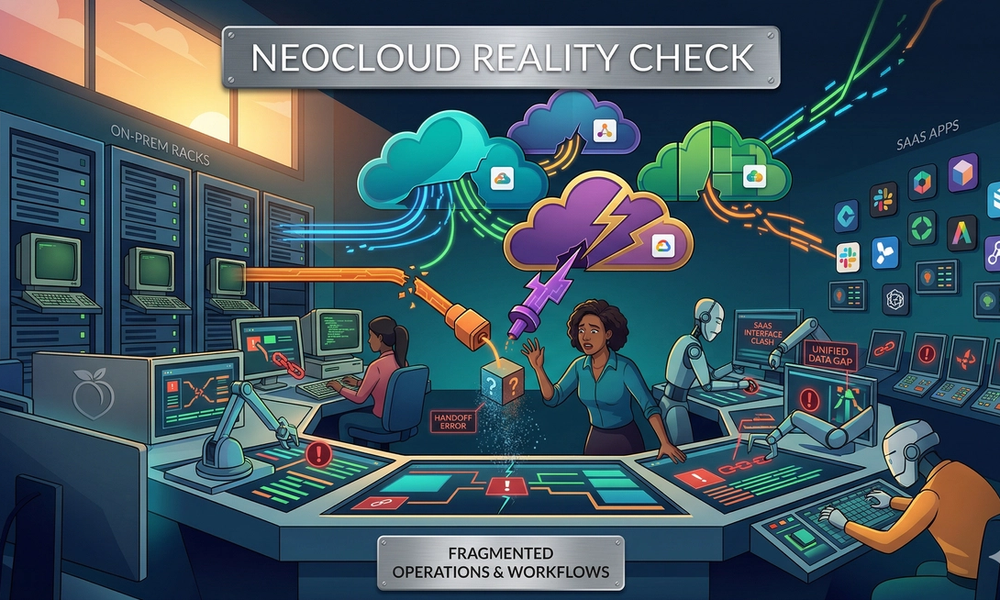
Modern enterprises increasingly depend on interconnected cloud environments to support operational scale and AI-driven workloads. However, as organizations expand across more providers and platforms, infrastructure coordination becomes significantly more difficult.
How Multi-Cloud Expansion Creates Operational Complexity
As companies adopt more cloud infrastructure, they frequently utilize a mix of platforms such as Amazon Web Services, Google Cloud, and Microsoft Azure to construct complex hybrid architectures. While multiple providers aid scalability, the approach inherently creates architectural complexity. Each platform has its own processes, controls, and workflows, which makes it harder for systems to work together smoothly, especially as teams integrate GPU cloud services into their environments.
Those environments increasingly depend on scalable GPU infrastructure, flexible virtual machines, and distributed cloud storage systems capable of supporting AI-driven workloads.
Why Toolchain Sprawl Slows Infrastructure Coordination
Consequently, toolchain sprawl emerges as a severe operational bottleneck. Instead of making work easier, using too many disconnected tools can slow teams down and make routine changes harder to manage. Different systems may handle the same task in different ways, which creates confusion, complicates infrastructure management, and increases the chance of mistakes.
Toolchain sprawl frequently manifests through several operational symptoms.
- Duplicated operational workflows
- Inconsistent deployment processes across cloud providers
- Fragmented visibility between engineering teams
- Slower infrastructure updates
- Rising coordination overhead in multi-cloud environments
Many businesses still rely on traditional cloud providers, traditional cloud platforms, and traditional hyperscalers because those systems remain central to daily operations. At the same time, customer demand is pushing organizations to become more flexible. These compounding pressures frequently expose gaps in operational maturity, especially when these environments expand faster than teams can coordinate them.
Neocloud Infrastructure vs. Traditional Cloud
The differences between traditional cloud architecture and neocloud infrastructure become more apparent as enterprises scale across multiple environments. Traditional providers prioritize broad software ecosystems, whereas neoclouds focus entirely on delivering massive raw compute power.
How Neocloud Infrastructure Differs From Traditional Cloud Platforms?
Traditional cloud services operate within their own isolated ecosystems. Platforms like AWS or Microsoft Azure provide massive computing power but force users to rely heavily on their specific proprietary tools. Neocloud providers supply specialized physical infrastructure built specifically for high-intensity GPU workloads.
Orchestration software like Itential connects these specialized hardware environments with traditional platforms to prevent data lock-in. Organizations gain the freedom to run specific workloads, including machine learning models and generative AI applications, where they perform best while managing everything from a unified control plane.
How Itential Approaches Infrastructure Coordination
Enterprises operating across fragmented cloud environments require systems capable of coordinating infrastructure without forcing complete platform replacement. That challenge has increased demand for orchestration-focused approaches built around integration and operational flexibility.
Itential focuses on helping enterprises connect systems instead of replacing them. That matters for organizations working across a limited set of vendors while also trying to support older systems and newer platforms at the same time.
Why Connector Ecosystems Matter in Enterprise Infrastructure
The company’s approach is built for connector ecosystems, and the connectivity teams responsible for making those ecosystems work. Rather than forcing a complete rebuild, it helps organizations coordinate existing tools across different environments. Teams require smoother deployment cycles without hitting integration bottlenecks inside their daily data pipelines.
That becomes increasingly important as enterprises process large language models, massive datasets, and other workloads requiring consistent high throughput performance.
Why Enterprises Are Exploring the Neocloud Provider Model
These integration strategies reflect a larger change in cloud computing. More enterprises are realizing they may need something beyond the standard model offered by cloud infrastructure providers and cloud operators. That is one reason the idea of a neocloud provider is gaining attention. It suggests a way to support flexibility without depending entirely on traditional hyperscalers.
By helping organizations meet architectural requirements across mixed systems, this kind of model supports a better combination of new opportunities while reducing the friction that often comes with fragmented operations.
Why Hybrid and Multi-Cloud Environments Are Harder to Manage
Hybrid and multi-cloud strategies provide greater flexibility, but they also introduce operational complexity at a much larger scale. As AI workloads continue expanding, infrastructure coordination becomes increasingly difficult to maintain.
AI Infrastructure Is Increasing Multi-Cloud Complexity
The growth of cloud computing is now tied more closely to the next phase of AI infrastructure. As organizations invest more heavily in AI infrastructure, they also need systems that can deliver higher capacity, faster access, and better performance. Workloads driven by artificial intelligence, machine learning, and generative AI demand highly specialized infrastructure powered by NVIDIA GPUs that older systems struggle to provide.
Infrastructure Scaling Creates New Physical Limitations
While beneficial for scaling, specialized hardware requirements introduce significant practical challenges. More demand means more pressure on the underlying data center infrastructure behind digital services. Enterprises must also coordinate data management, object storage, and scalable networking architectures capable of handling growing operational complexity. It raises questions about power availability, electrical capacity, and electrical availability.
Enterprises scaling AI infrastructure must also account for several physical limitations.
- Network aggregation bottlenecks
- GPU power consumption
- Fiber connectivity limitations
- Cooling requirements inside data centers
- Latency-sensitive workload distribution
As businesses expand across more cloud providers, these problems become harder to ignore. Growth can create greater variability in performance, cost, and reliability. Without strong coordination, companies may end up with more complexity instead of more value. Proper oversight of the underlying physical infrastructure becomes essential when assets are divided between traditional data centers and third-party colocation facilities.
Neocloud Migration Challenges
Integrating neocloud infrastructure into your existing operations introduces both technical and organizational obstacles. Enterprises must manage security, compatibility, scalability, and operational continuity simultaneously.
Security and Compatibility Remain Major Migration Barriers
Integrating these high-performance compute clusters introduces several immediate technical hurdles. Technical teams frequently encounter compatibility issues when trying to link legacy systems with modern API-driven architectures. Security presents another major roadblock; expanding operations across multiple environments drastically multiplies the potential attack surface and elevates enterprise concerns regarding data sovereignty and sensitive information protection.
Companies must establish strict access controls that work universally across all connected platforms to stay protected. Organizations must also prepare stronger disaster recovery strategies as workloads become more distributed across providers. Securing talent with the specialized skills required to orchestrate these complex multi-vendor ecosystems also remains a constant struggle for enterprise IT departments.
Three Pillars of Predictable Infrastructure Operations
Long-term infrastructure stability depends less on isolated technologies and more on how systems operate together at scale. Enterprises pursuing sustainable cloud growth must prioritize operational consistency, scalability, and financial efficiency simultaneously.
To handle that complexity, enterprises need a clearer and more consistent approach. The primary objective goes beyond simply procuring new technology; organizations must ensure existing systems integrate seamlessly to support long-term performance. Hardware synchronization between dedicated servers, bare metal environments, and expansive storage systems remains the only reliable way to sustain high performance at scale.
Operational Maturity and Ecosystem Readiness
Operational maturity matters because scale alone does not guarantee stability. A company can invest heavily in infrastructure and still struggle if teams cannot manage it effectively.
Consequently, ecosystem readiness and continuous expansion remain critical operational priorities. Businesses need systems that can support growth, accelerate cloud adoption, and remain useful and sustainable over time. They also need a path toward economic viability, especially after early use cases move into broader adoption.
Future Scalability and Higher Capacity
Modern infrastructure also needs to support future scalability. Proactive planning requires anticipating higher capacity immediately while preparing for shifting organizational demands in the coming years. Compute limits will be tested frequently as teams scale up their ai training efforts and execute complex model training for extremely large models.
Teams must think beyond short-term fixes and prepare for expanding infrastructure challenges tied to AI scalability and distributed computing demands. They need systems that can adapt to greater variability in demand without becoming harder to manage. That is especially important as companies build for larger workloads and more distributed services.
Lower Costs Without Compromising Performance
Businesses are also under constant pressure to control spending. Enterprises demand lower operational costs without sacrificing high-end computing performance. Organizations increasingly prioritize specific operational adjustments to improve cost efficiency.
- Better workload orchestration
- Infrastructure consolidation
- Optimized cloud resource allocation
- Reduced duplicated tooling
- More efficient managed cloud service utilization
Maintaining this financial balance proves highly difficult when operating fragmented systems. When organizations improve coordination across cloud infrastructure providers, they can reduce duplicated work and make better use of what they already have. IT leaders must carefully weigh whether leaning on managed cloud services for real-time inference tasks makes more financial sense than financing their own infrastructure. That creates a stronger foundation for growth without forcing unnecessary tradeoffs.
Governed Coordination Replaces Fragmented Execution
As enterprise infrastructure becomes more connected, organizations require stronger governance models to maintain operational consistency. Fragmented execution creates risks that become more severe as infrastructure environments expand.
Why Platform Alignment Matters at Enterprise Scale
This is especially true when active technologies are supporting operations at an enormous scale. In those conditions, even a small disconnect between systems can create larger problems. The answer is not always adding more software. Often, it is improving how systems work together.
Therefore, enterprise leaders are actively abandoning fragmented execution in favor of strict platform alignment. Strong orchestration software provides the framework needed to enforce platform alignment across the entire organization.
From Fragmented Systems to Coordinated Infrastructure
Enterprise infrastructure strategies are shifting away from isolated platform management toward coordinated operational ecosystems. That transition reflects broader changes in cloud scalability, AI infrastructure demand, and enterprise modernization priorities.
Why Enterprises Are Prioritizing Coordinated Infrastructure
The move from fragmented systems to coordinated infrastructure reflects a broader change in how enterprises think about growth. Companies are no longer just adding tools, storage layers, and disconnected software environments. They are trying to build environments where cloud providers, internal systems, and external platforms work together more effectively. Enterprises invest heavily in these specialized compute providers to minimize network latency and run complex models efficiently.
The Neocloud Market Continues Expanding
Many of these organizations are also trying to improve performance for workloads involving large volumes of data distributed across multiple environments.
That change is being shaped by several forces. Competition drives innovation among cloud operators. Infrastructure decisions are increasingly tied to real estate, available power, and long-term efficiency. At the same time, many organizations are still working across a limited set of vendors, which makes coordination even more important.
For businesses operating in hybrid and multi-cloud environments, success depends less on how many tools they have and more on how well those tools fit together. A well-designed neocloud infrastructure allows businesses to bridge the gap between legacy systems and modern cloud demands.
Why Neocloud Infrastructure Matters Now
Modern enterprises can no longer rely on disconnected infrastructure strategies to support long-term scalability. Coordinated cloud operations are becoming essential for maintaining performance, flexibility, and operational visibility.
Coordination Is Becoming More Important Than Expansion
The challenge facing enterprises today is not just growth. It is managing growth without creating more fragmentation.
A strong neocloud infrastructure strategy can help organizations bring more structure to modern operations. It gives businesses a way to align systems across cloud providers, improve coordination, strengthen data storage visibility, and reduce inefficiencies that come from disconnected environments.
Effective neocloud infrastructure strategies provide enterprises with several core capabilities.
- Reduce operational fragmentation
- Improve infrastructure visibility
- Support scalable AI workloads
- Strengthen cross-platform coordination
- Maintain long-term operational flexibility
Companies that effectively orchestrate their neocloud infrastructure gain the exact visibility needed to keep sprawling digital environments under control.
That matters in a world shaped by cloud computing, evolving architectural requirements, and rising expectations around performance. The organizations that manage this well will be better positioned to support long-term change without losing control of the systems they depend on.
Peach State Tech continues covering the Georgia companies, platforms, and infrastructure strategies shaping the future of cloud infrastructure, AI infrastructure, and enterprise systems. Follow Peach State Tech for more insights into how Atlanta-based innovation is influencing the next phase of modern technology.